Snow Removal Industry: Market Size, Trends and What Contractors Should Know
The US snow and ice management industry generates $23 billion a year across 88,200 businesses. Here is what drives it — pricing, insurance, technology, weather — and where it is headed.
The snow removal industry in the United States is a $23 billion market spread across 88,200 private-sector businesses. This page covers the numbers that define it — pricing models, insurance exposure, technology adoption, salt supply and the weather patterns that move revenue — and links to deeper coverage across each topic.
Industry size and structure
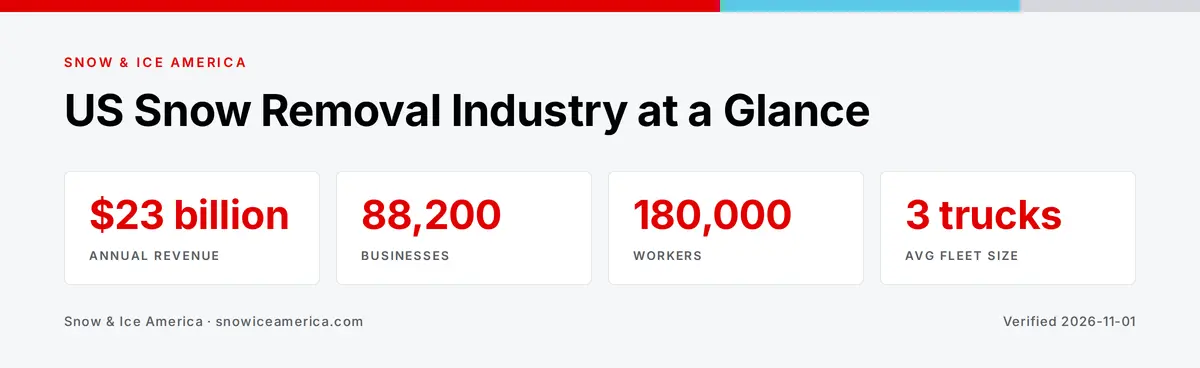
The Snow and Ice Management Association (SIMA) Foundation’s Industry Impact Report and IBISWorld put the US snow and ice management industry at roughly $23 billion in annual revenue, generated by an estimated 88,200 businesses employing about 180,000 workers.
The market is extremely fragmented. The four largest operators account for approximately 5 percent of total revenue, according to IBISWorld. Four in five snow businesses are sole proprietorships. The average operator earns 37 percent of total revenue from snow and ice services; only about 15 percent are snow-only companies. The rest are landscapers, paving contractors or property-maintenance firms that add winter work as a seasonal line. The typical fleet is three dump trucks with plows, per SIMA Foundation benchmarking data.
Private equity has taken notice. CT Acquisitions’ roll-up tracker counts 16 or more active acquisition platforms and 108 transactions through September 2025. Consolidation is concentrating in the $2 million to $10 million revenue band — owner-operators large enough to have documented contracts and recurring commercial clients, small enough that the founder is still the key-person risk.
Market research firms — including Research and Markets and GM Insights — project a compound annual growth rate of 4 to 6 percent through 2035. The demand drivers are commercial property growth, urbanization and the rising bar that insurance underwriters set for documented, certified snow services.
Pricing models and revenue
Snow removal contracts cluster around five pricing structures. SIMA Foundation data from its 2025 financial-benchmarking survey breaks out the mix: seasonal contracts at 25 percent, per-push at 24 percent, per-inch at 21 percent, time-and-materials at 16 percent and per-event at 14 percent. Each model shifts weather risk differently between the contractor and the client. For a detailed breakdown, see Commercial Snow Removal Pricing: How to Estimate Per Push, Per Inch, or Per Season.
Revenue per truck ranges from $35,000 to $75,000 in a normal season. Heavy winters with strong contract books can push a truck past $100,000. Equipment billing rates vary by machine class: dump trucks with plows run roughly $200 per hour, wheel loaders around $160 per hour and spreaders roughly $135 per hour, according to industry benchmarking data.
Margins depend on the client mix. Commercial work typically yields 25 to 45 percent gross margin; residential work runs higher at 40 to 60 percent, partly because per-push residential pricing absorbs less weather risk and partly because route density is harder to optimize. The full cost picture — equipment depreciation, insurance, salt, labor, fuel — is covered in our cost breakdown of owning a snow plow business.
The Snow Removal Quoting Calculator on this site lets contractors model per-push, per-inch and seasonal pricing against their own cost inputs.
Insurance and liability
Slip-and-fall claims are the industry’s central liability exposure. Individual claims commonly settle between $50,000 and $500,000, and more than 30,000 are filed annually across the United States, according to National Safety Council data and insurance-industry reporting.
General liability insurance for a snow removal business carries a median premium of about $132 per month, per Insureon. Commercial auto insurance — required for any truck with a plow — averages $299 per month. Insurers have been tightening snow-specific coverage: carriers increasingly require documented service logs, GPS verification of service times and, in some cases, SN 9001 certification or a Certified Snow Professional (CSP) credential from the Accredited Snow Contractors Association (ASCA) and SIMA, respectively.
The practical consequence for contractors is that insurance is no longer a line item you set once a year and forget. Premiums reflect documentation quality, and undocumented service is becoming uninsurable for commercial accounts. For more on what the insurance industry expects, see The Insurance Industry’s View on Winter Liability.
Technology and the labor squeeze
Labor is the constraint that shapes most operational decisions in the snow removal industry. The Bureau of Labor Statistics puts the mean wage for landscaping and groundskeeping workers — the classification that captures most snow laborers — at $19.65 per hour, with hourly wages having risen 4.2 percent in the third quarter of 2024. Snow removal is the number-one industry for H-2B seasonal work visas; the United States Department of Labor certified 50,134 H-2B positions in fiscal year 2024, more than any other sector.
Technology adoption is split by company size. GPS fleet tracking is used by roughly 70 percent of large operators (10 or more trucks) but only about 35 percent of smaller firms. The gap matters because GPS logs are increasingly what insurers and property managers accept as proof of service. Snow management software — route optimization, automated client notifications, digital service verification — is moving from a competitive advantage to a baseline expectation on commercial bids.
On the equipment side, autonomous plowing is in early commercial deployment. Toro announced commercial autonomous snow-clearing modules in January 2026, and Teleo’s teleoperated Storm plow has been in limited commercial use since March 2024. Mixed fleets — UTVs working alongside full-size trucks — are another response to the labor shortage, particularly for sidewalk and parking-island detail work that a dump truck cannot reach.
Weather, salt and the season ahead
Weather and salt supply are the two uncontrollable variables in snow removal profitability, and both are volatile. A mild winter can cut a contractor’s income by 20 to 40 percent and compress margins by 15 to 25 percent, according to trade and academic analysis. Hybrid contracts — a reduced seasonal base plus per-event overage — are the emerging risk-sharing response. See The Pros and Cons of Seasonal vs. Per Push Snow Contracts for a fuller comparison.
Salt supply is under structural pressure. Bulk rock salt contracts for the 2026–27 season range from $30 to $80 per ton depending on region and volume, but spot-market prices reached approximately $300 per ton during the 2025–26 shortage — roughly triple the contracted rate. A Gulf Coast mine closure removed an estimated 2.5 million tons per year of domestic supply, and pre-season bids for the coming winter have reached $152 per ton in some Northeast markets, per industry reporting from MaxiSalt and Abraxus Salt. Detailed pricing data is in our Rock Salt Prices and Supply for Winter 2026–27 report.
The El Nino-Southern Oscillation (ENSO) cycle is the dominant seasonal signal for North American winter weather. The current El Nino phase and its pricing implications are covered in 2026–27 El Nino Winter Forecast and El Nino Winter 2026–27: What Snow Contractors Should Price For.
Certifications and standards
Snow removal certifications and industry standards are set by two trade bodies, not by a single federal regulator.
- SIMA offers the Certified Snow Professional (CSP), the primary individual credential. The CSP tests knowledge of operations, safety, documentation and environmental practices. SIMA also publishes the industry benchmarking data referenced throughout this page.
- ASCA administers SN 9001, a company-level quality-management certification accredited by the American National Standards Institute (ANSI) since January 2014. SN 9001 requires documented standard operating procedures, calibrated equipment, training records and a continuous-improvement framework.
Government touchpoints exist but are narrow: the Department of Transportation requires a commercial driver’s license (CDL) for certain plow configurations above 26,001 pounds GVWR; the Department of Labor administers H-2B visa certification; and state-level slip-and-fall liability statutes determine who bears responsibility for ice-related injuries on commercial property.
Both CSP and SN 9001 are increasingly referenced in commercial RFPs and insurance underwriting. For a full breakdown of what each credential verifies, see Top Snow and Ice Certifications to Boost Credibility and Who Regulates Snow Plowing Standards and Operator Certifications.
Image credits: Photo: Dannel Malloy via Wikimedia Commons (CC BY 2.0)
Allan Robinson
EditorialThe Snow & Ice America editorial team tests and reviews plows, spreaders, and fleet tools with working contractors across North America. Independent. Never sponsored.
Price your next snow job in 60 seconds.
Estimate per-push, per-inch and seasonal pricing for any lot.