Parking Lot Snow Removal Is Autonomy’s Hardest Problem
Autonomous snow removal works on runways and driveways. A commercial parking lot has none of the properties that made those environments solvable.
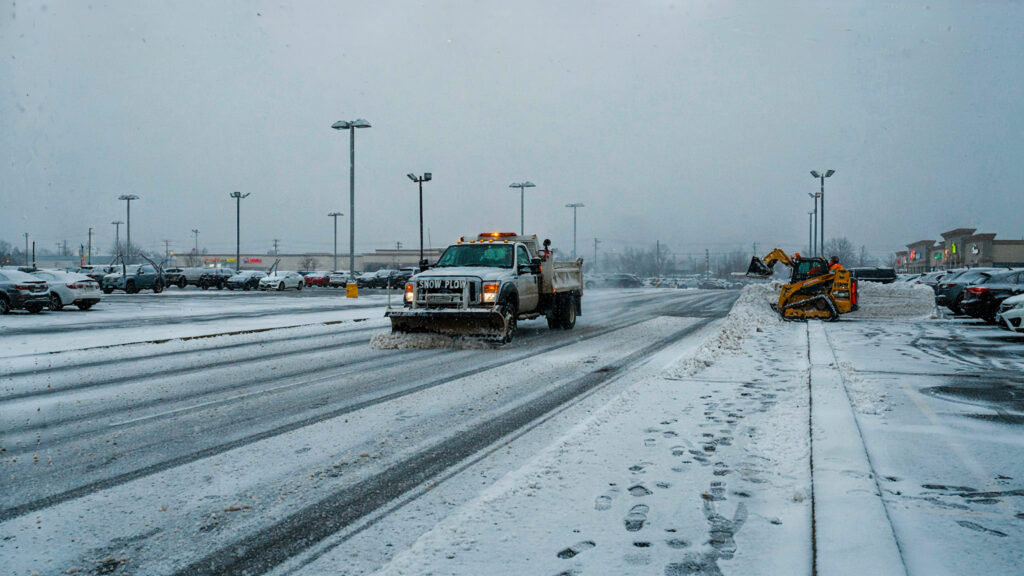
A parking lot is harder to plow than a highway. That claim sounds backwards to most people outside this industry and obvious to almost everyone in it, and the distance between those two reactions is the reason autonomous snow removal is currently being sold on evidence that does not apply.
Our position is straightforward. Autonomous snow clearing has genuinely succeeded at fleet scale in two environments. Neither of them is a commercial parking lot, and neither of them resembles one in the properties that made autonomy tractable. Every time a contractor is shown a runway video or a viral driveway robot as proof that the lot is next, that contractor is being asked to extrapolate from the easy case.
Three different technologies are wearing one label
Autonomous snow removal currently describes three separate product categories that share almost nothing but a verb.
The first is airside autonomy: full-size runway sweepers and plows operating without a driver at commercial airports. The second is supervised teleoperation of conventional heavy equipment, where a person runs the machine from a room somewhere else. The third is consumer yard robotics, the category that produced the $4,999 driveway units now circulating on social video.
These get reported as one story and they are not one story. The first is mature and running in production. The second is commercially available and carefully hedged by its own vendors. The third is a residential appliance whose performance says nothing about a 400-space retail lot at two in the morning. A contractor evaluating the second category deserves to have the first and third kept out of the pitch.
What autonomy has already accomplished, and it is not small
Oslo Airport Gardermoen is the strongest case the technology has, and it deserves to be stated at full strength rather than minimized.
Norwegian airport operator Avinor began procuring autonomous runway sweepers under a framework agreement worth up to 40 million euros over eight years. Överaasen builds the machines and Yeti Move supplies the autonomy. The first tranche covered twelve units. According to Överaasen chief executive Thor Överaasen, four RS 600 Performance Line machines can clear a 3,500-metre runway in under eight minutes; the plough alone measures more than ten metres wide. All twelve units at Oslo were slated to run autonomously during the 2022-23 winter, and Yeti Move has since reported observing six of them working in formation during a January operation, coordinated with air traffic control over minimal radio traffic.
‘ .
. ‘
That is not a demonstration. That is a production winter operation on one of Scandinavia’s busiest airfields, and the same company now lists Frankfurt, Istanbul, Vienna and Stockholm alongside Oslo. Anyone dismissing autonomous snow clearing as vapourware is arguing against the evidence.
The question is what that evidence is evidence of.
What a runway gives a machine that a lot never will
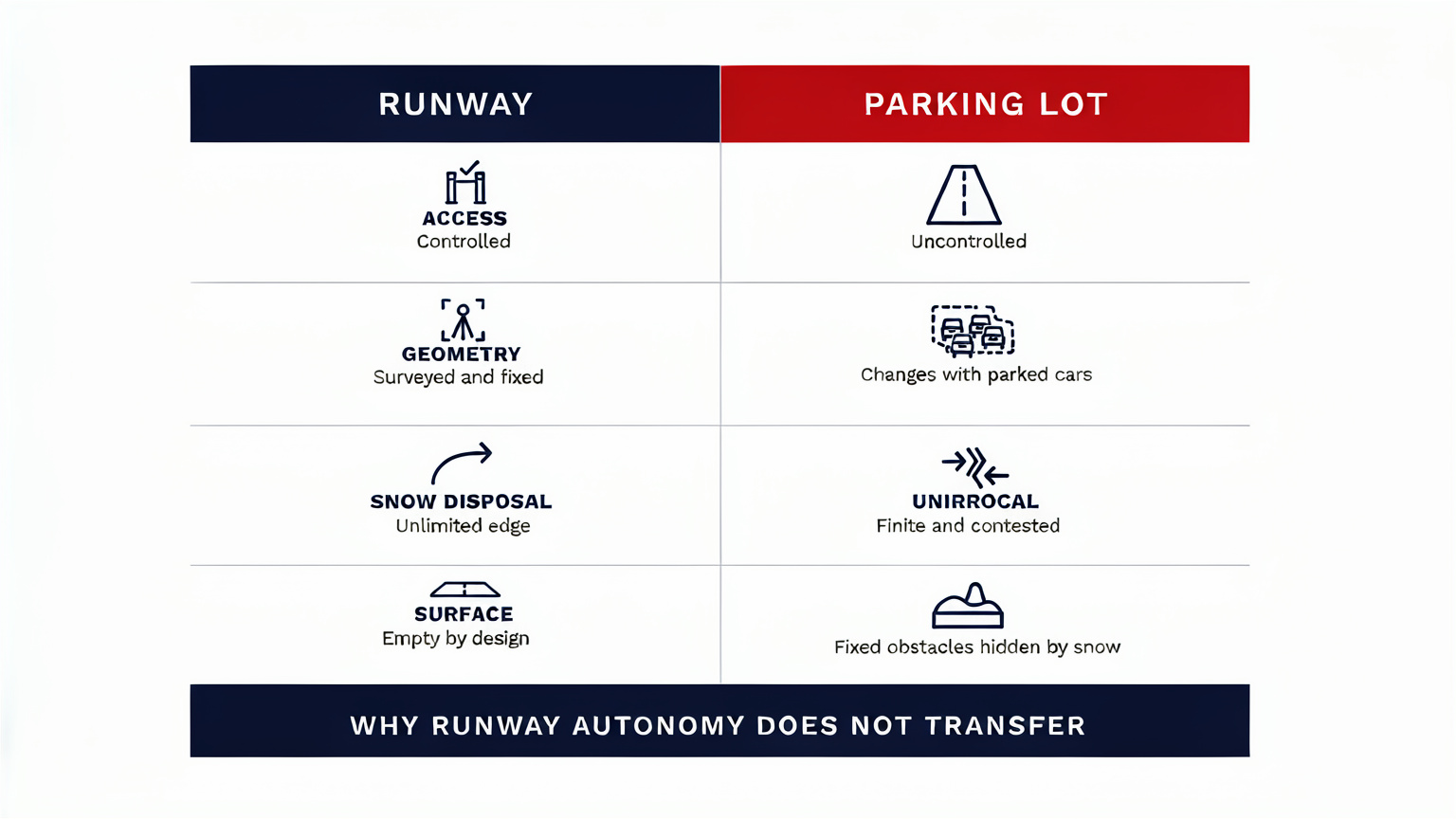
A runway is not merely a large flat surface. It is an environment engineered to remove exactly the variables that make autonomy hard, and it removes four of them at once.
Access is controlled. Nothing enters a runway during a clearing operation without clearance. No delivery van, no employee arriving early, no pedestrian cutting across. The Oslo operation coordinates with air traffic control, which is another way of saying the machines work inside a permission system that a retail lot does not have and cannot be given.
The geometry is surveyed and fixed. Semcon’s control system builds digital clearing patterns and the vehicles hold position to centimetre precision using RTK GPS corrections. That works because the surface is a known, maintained, precisely mapped rectangle. It does not change between storms.
The snow has somewhere to go. Gang plowing at an airport works by lining machines up diagonally so each pushes snow into the next, walking the accumulation off the edge of the pavement. The edge is the answer. A runway has an effectively unlimited disposal boundary running its entire length.
The surface is empty by design. Not incidentally empty but structurally so, because anything sitting on a runway is a hazard independent of snow.
Now hold a commercial lot against those four. Access is uncontrolled. Geometry changes with every vehicle left overnight. Disposal space is finite, contested, and revenue-generating when it is not full of snow. And the surface is populated with fixed obstacles that the snow itself conceals.
The last twenty percent of the lot is where the work actually lives
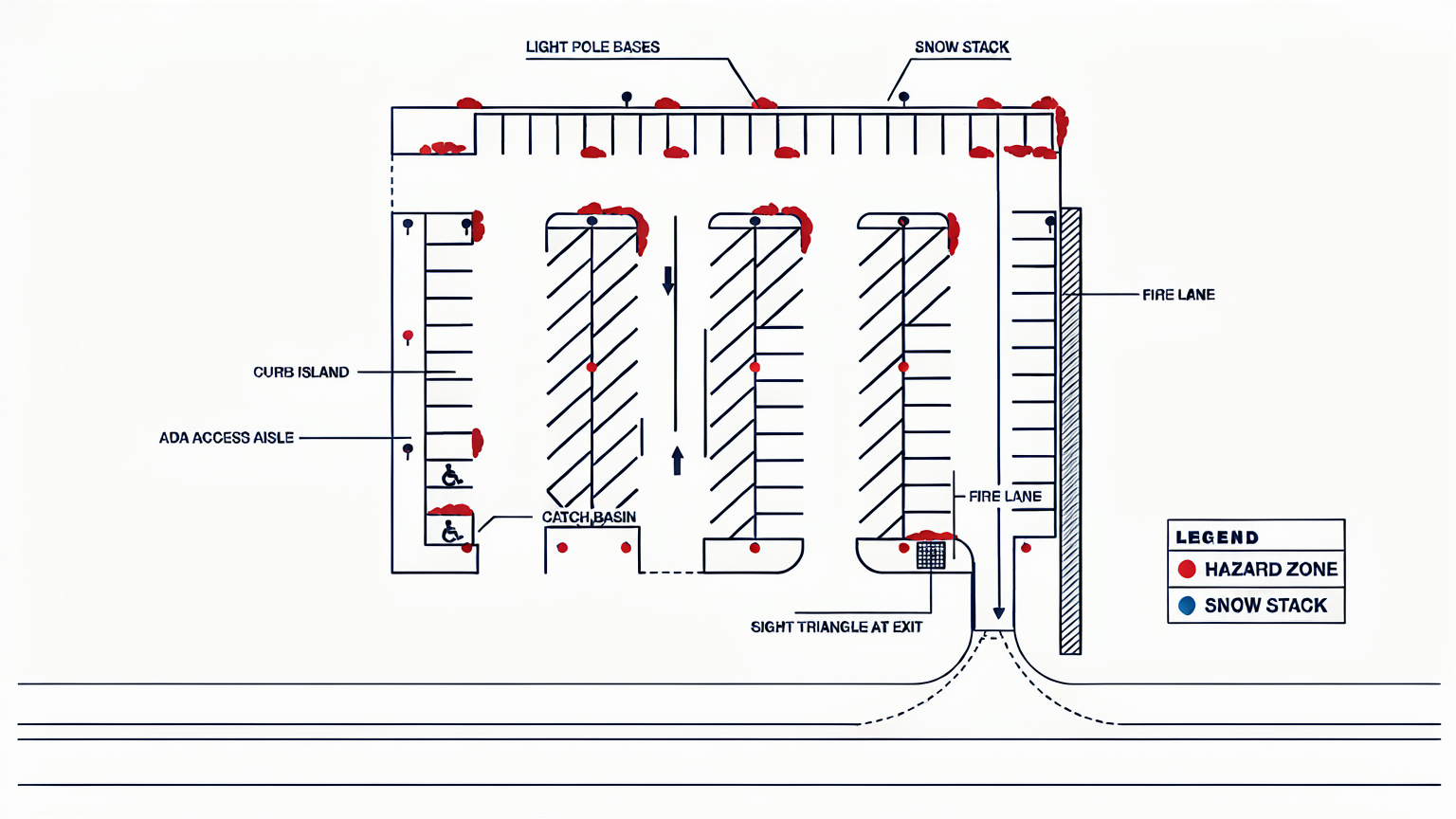
Ask an experienced operator what makes a lot slow and the answer will not be the drive lanes. Drive lanes are the runway-like part, and they are perhaps two-thirds of the square footage and a third of the clock.
‘ .
. ‘
The rest is a part structure that has to be handled individually. Curb lines and islands that determine blade height while invisible. Light pole bases. Cart corrals that moved between storms. Wheel stops and speed bumps under six inches of cover. Bollards and pump islands that force backdragging instead of pushing, because there is no room to carry a windrow past them. Fire lanes where clearance is a code obligation rather than a service preference. Catch basins that must not end up under a pile. Sight triangles at the egress, where a badly sited stack becomes a traffic hazard rather than a snow problem.
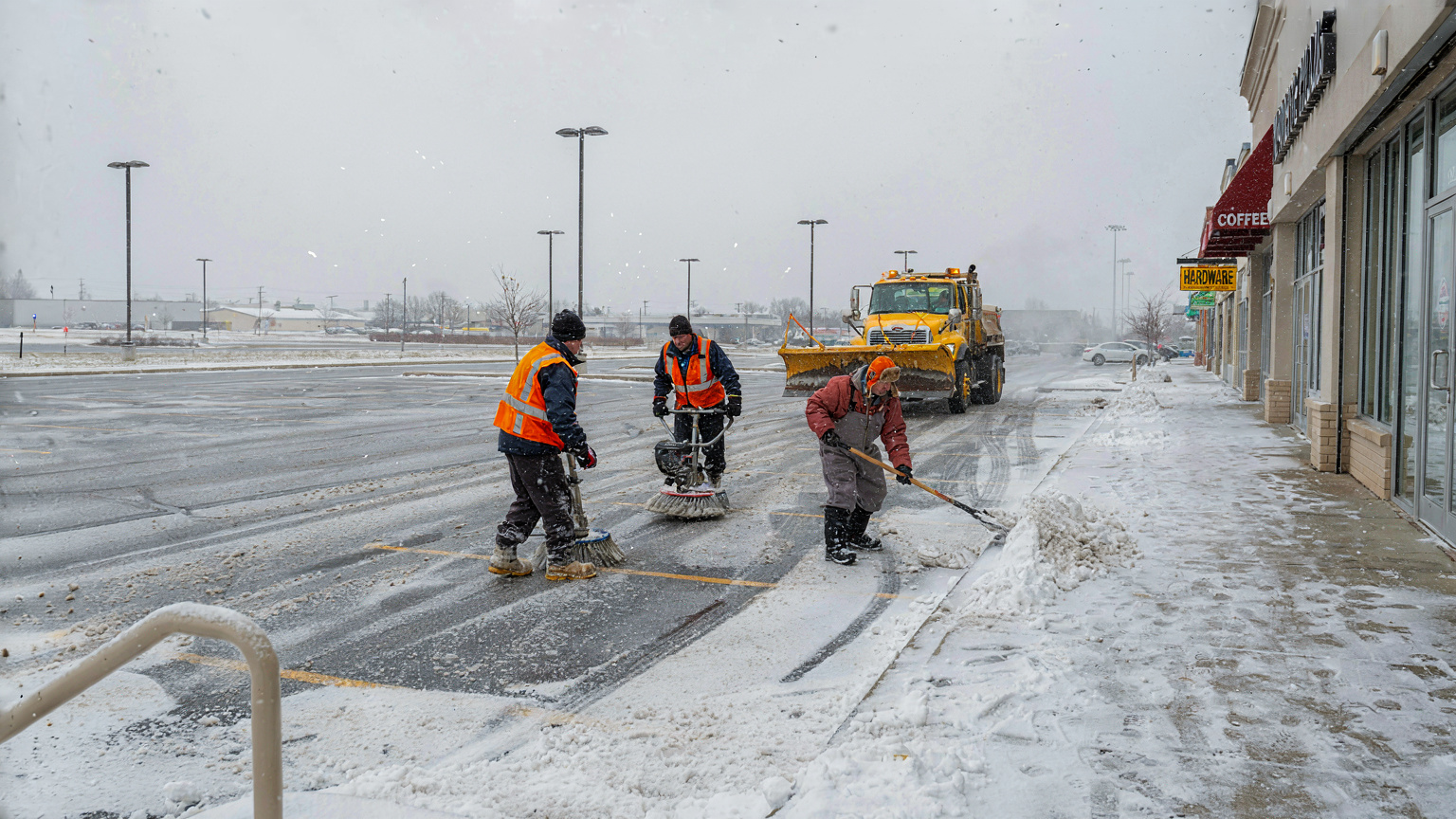
Consider one of these closely. An ADA access aisle is the striped area beside an accessible stall, and it exists so that a wheelchair lift has room to deploy. Clear the stall by pushing snow sideways and the aisle fills. The stall now looks serviced and is functionally useless, and the failure is invisible in an aerial photo and invisible in a GPS breadcrumb trail. Knowing that the aisle is the thing that matters, and that it must be cleared toward a specific direction, is a piece of judgment carried by an operator who has been on that site before.
‘ .
. ‘
Equipment manufacturers describe the same problem from the other side. SnowWolf’s own technique guidance notes that even large lots are cluttered with light poles and parked cars, that tight corners create snow containment problems, and that backdragging between pumps and vehicles is a routine requirement rather than an exception.
Where the pile goes is an accumulated judgment, and the patents concede it
Snow stacking is the decision that separates a serviceable lot from a lot that generates a claim in March, and it is the decision autonomous systems are furthest from making.
A stack sited on the uphill side of a walkway produces meltwater that crosses the walkway and refreezes overnight. A stack over a catch basin removes the drainage the thaw depends on. A stack in a sight triangle blinds drivers pulling out. A stack in the wrong corner in December is still there in February, compounding, because it was placed without reference to where the rest of the season’s snow would need to go.
The clearest admission of this comes from the patent literature rather than from any vendor’s marketing. US Patent 11,993,284 covers an autonomous winter service vehicle, and its background section states plainly that the routes driven by winter service vehicles conventionally rely on the expertise and prior experience of the human operator to determine an appropriate route and the resulting location for removed snow. The patent then proposes automating that determination through route simulation, weighing factors including snow pile size, water run-off from melt, and accident probability. Reading that as an industry document rather than a legal one: the people building the systems understand precisely which judgment they are trying to replace, and they are describing it as an open problem to be solved rather than a solved one.
Sensors degrade in exactly the conditions that create the work
Winter perception is difficult in a way that is easy to underestimate from a clear-weather demonstration.
A 2026 preprint on autonomous trucking in winter conditions catalogues the failure modes: LiDAR returns scatter and attenuate in heavy snowfall, producing noisy data; ice and slush accumulate on sensor housings and occlude the field of view; cameras lose the contrast between a snow-covered surface and its lane markings; radar tolerates precipitation well but lacks the resolution to classify objects finely. The authors also make the point that black ice is visually indistinguishable from dry pavement, and that localisation degrades once snow covers the features a system was using to locate itself.
That work concerns highway trucking rather than parking lots. It should not be stretched further than it goes. But the direction of the problem transfers cleanly, and it gets worse rather than better in a lot: the features that a system would use to localise are painted stall lines, and stall lines are under the snow before the first push.
The concrete version of this shows up somewhere unexpected. At the collegiate autonomous snowplow competition run by the Institute of Navigation, obstacles on the course simulate parking meters and mailboxes, and one judge described a recurring failure: a plow blade held at an angle behaves like a lever with several hundred pounds of snow pushing back against it, and at least one team arrived with control tuning done indoors, without those forces present. Their machine could not hold a line. Small detail, student event; also a precise description of why demonstrations keep overstating readiness.
The strongest counterargument, stated properly
The best objection is that nobody serious is claiming full autonomy in lots, and that the argument above is aimed at a target the industry has already abandoned.
That objection has real force. Teleo and Storm Equipment introduced their commercial offering as remote-operated first and added autonomous capability afterward. Their pitch is explicitly that one supervised operator can cover work across multiple regions from a command centre. Teleo’s own framing has included the observation that today’s streaming gamers could become tomorrow’s remote plow operators. That is a labour argument rather than an autonomy one. Keeping a human in the loop is the honest answer to everything written above.
More striking, the market is already conceding the geometry. Frost-E Robotics builds a resident on-site machine and positions it against walkways, steps, courtyards and townhouse paths. Frost-E describes that detail work as the slowest part of route completion and the highest risk zone for slip-and-fall claims. The company’s stated goal is to make an entire site as quick and easy as an empty parking lot. A vendor selling autonomy has written the empty lot into its marketing as the definition of the easy case. That is the argument of this piece appearing in a competitor’s sales copy.
Where the objection fails is in what gets communicated downstream. Supervised teleoperation is a genuinely useful product and a genuinely different one, and the trade coverage that flattens it into the same category as a runway fleet is the reason contractors form expectations that the equipment cannot meet. The category error is not in the engineering. It is in the reporting, and this publication has participated in it.
What this means for a contractor being sold something
We are not arguing against buying autonomy. We are arguing that the buying question has to be asked in terms of environment rather than machine, because the environment is what determines whether any of it works.
Useful questions to put to a vendor, each of which has a checkable answer:
- Which control mode is running: remote operation, supervised autonomy, or unattended autonomy? Ask for the answer in those words.
- What happens when a vehicle is parked where the plan assumed pavement?
- Who decides where the pile goes, and does that decision persist across the season or reset each storm?
- What is the documented behaviour when a person enters the work area, and what is the stopping distance at working speed?
- Which sites has this run on for a full season, and may we speak to the operator?
The last one matters most, and a vendor with two production winters behind them will answer it easily.
Autonomy is coming to this industry, and the runway operators have already shown it is possible when the environment cooperates. The commercial lot is the version where the environment does not cooperate, and it is going to be last, not next. Anyone selling otherwise is selling the drive lanes and hoping nobody asks about the rest of the site.
Final thoughts
For now, autonomy is not a realistic purchase for most of the industry. The landscape contractor running snow removal as a side hussle, and the mid-tier commercial provider balancing a book of regional sites, are buying neither the runway fleet nor the supervised systems priced for national operators: on today’s evidence the equipment is not feasible on cost, and not feasible on effectiveness, because no system yet handles the parts of a lot where the work and the liability actually live. That will change, and the trajectory from Oslo’s runways is real, but it will change at the top of the market first. Until it reaches the middle, the honest position is neither adoption nor dismissal: watch which environments the vendors can actually prove, keep the vendor questions in the file, and let the empty lot remain the easy case that someone else’s machine has to solve.
Frequently asked questions
Can autonomous snow plows clear a commercial parking lot?
Autonomous snow plows can clear the open portions of a commercial parking lot under supervision, and the commercially available systems in North America are currently sold as remote-operated or supervised rather than unattended. No system available at the time of writing is documented as handling a full commercial site, including detail work and seasonal pile management, without a human directing it.
Where is autonomous snow removal actually in use today?
Autonomous snow removal is in production use at airports. The most visible case is Oslo Airport Gardermoen, where a fleet of autonomous runway sweepers supplied by Överaasen with Yeti Move autonomy has operated in formation on live airside operations. Commercial site deployments in North America exist but are supervised, and are far smaller in number.
Why is a parking lot harder to automate than a road or runway?
A parking lot is harder to automate because it has uncontrolled access, geometry that changes between storms as vehicles come and go, finite space to dispose of snow, and fixed obstacles that the snow conceals. A runway removes all four of those conditions by design.
Do LiDAR and cameras work in falling snow?
LiDAR and camera performance both degrade in falling snow. Published work on winter autonomous driving describes LiDAR returns scattering in heavy snowfall, sensor housings occluding as ice and slush accumulate, and cameras losing the contrast needed to read surface markings. Radar is more tolerant of precipitation but resolves objects less finely.
What does autonomous snow removal equipment cost?
Verified pricing for commercial autonomous and teleoperated snow equipment is not publicly available in a form we are willing to publish. The figures circulating in market-research summaries and vendor-adjacent content do not carry methodology we can check. We would rather report the gap than fill it.
View sources
- Avinor framework agreement and autonomous runway sweeper procurement, via Robotics & Automation News (2021), reporting Avinor and Överaasen statements.
- Överaasen RS 600 Performance Line specifications and Oslo Airport autonomous deployment, Airside International (2024), quoting CEO Thor Överaasen.
- Yeti Move, “Experiencing the Future of Snow Removal at Oslo Airport” (2025), company account of formation operations.
- Yeti Move, About page, airport customer list.
- Semcon, Yeti project case page, RTK GPS pattern control system.
- New Atlas (2020), description of gang plowing method.
- Teleo and Storm Equipment launch release, PR Newswire (6 March 2024).
- ADAS & Autonomous Vehicle International (2024), Teleo remote operator commentary.
- Frost-E Robotics, product site, positioning and stated operating parameters.
- US Patent 11,993,284, “Autonomous winter service vehicle,” background and summary sections.
- arXiv preprint 2603.13296, winter operating conditions for autonomous trucking, perception and localisation sections.
- Communications of the ACM (2023), coverage of the ION Autonomous Snowplow Competition.
- SnowWolf, “The Most Efficient Way to Remove Snow From Lots,” technique guidance on obstacles and containment.
- ABC7 (January 2026), consumer robotic snow blower pricing and owner account.
Kirk Davies
EditorialWith a career spanning over two decades in the snow and ice industry, and former owner of RWB Snow Service Group, Kirk propelled the company to the forefront of the industry while setting new standards for operational excellence and customer service. Kirk's contributions extend beyond his business achievements. He is a respected thought leader who shares his knowledge and insights throughout the snow and ice industry.
Price your next snow job in 60 seconds.
Estimate per-push, per-inch and seasonal pricing for any lot.