El Niño Winter 2026-27: What Snow Contractors Should Price For
The strongest August El Niño signal on record is a reason to widen contract bands, not to discount seasonal pricing.

Contractors are pricing winter 2026-27 against the strongest El Niño signal NOAA has ever carried this early in a bid season. The forecast that would settle the question arrives after the contracts are signed.
Bid season runs while the asphalt is too hot to stand on. Municipal solicitations for hauling and de-icing close through late August, property managers circulate RFPs for the coming winter, and the seasonal numbers that will govern a contractor’s revenue from November through April get committed on paper in a month when nobody has seen a snowflake in five months.
This August the numbers are being written against an unusually loud signal. On August 13, the Climate Prediction Center reported that El Niño was strengthening, with a greater than 90 percent chance of a very strong event during fall and winter 2026-27. The same discussion gave the October through December season a 69 percent chance of producing a historic event, defined as a three-month relative Oceanic Niño Index value of 2.5 degrees Celsius or higher, which would exceed every El Niño in the record back to 1950.
That is the loudest ENSO signal an August bid season has carried. The question for a contractor pricing a seasonal contract is what to do with it, and the answer is less obvious than the headline suggests.
What NOAA actually said
CPC’s August discussion described observed conditions, not a snowfall forecast. July index values stood at plus 1.4 degrees Celsius in Niño-3.4, plus 1.7 in Niño-3, and plus 2.9 in Niño-1+2. Subsurface temperature anomalies reached plus 10.0 degrees at depth, and the traditional and equatorial Southern Oscillation indices ran near two standard deviations negative through the month.
The agency attached its own qualifier to the strength number. With an event of this magnitude, CPC wrote, the chances of experiencing impacts consistent with El Niño are larger, but they are not guaranteed.
That sentence is the operative one for anyone building a bid. A probability shift is not a schedule. NOAA does not forecast seasonal snowfall totals at all, and the seasonal outlook package it released on August 20 deals in temperature and precipitation probabilities rather than inches on a parking lot.
The historical record, including the parts that argue against it
Strong El Niño winters have tended to produce a north-south split in United States snowfall. The Illinois State Climatologist’s office summarizes research drawn from 3,690 reporting sites, comparing eight strong El Niño winters against the other 38 winters between 1951-52 and 1996-97. That work found Midwest snowfall reductions on the order of 10 to 20 inches. Analysis published by NOAA covering El Niño winters from 1959 through 2023 shows the same pattern geographically: below-average snowfall across much of the northern tier and the Great Lakes, above-average snowfall in the Southwest, the southern and central Plains, and parts of the southern Appalachians. Weather Company analysis of strong El Niño seasons put Boston’s average reduction at close to 25 percent.
A contractor reading only that paragraph would price a light winter and move on. The variance inside those averages is where the money is.
Minnesota’s Department of Natural Resources notes that strong to very strong El Niño years in the Twin Cities ran below normal for snowfall with one exception, and the exception is instructive. The winter of 1982-83, one of the strongest events on record, delivered 16.5 inches on December 27 and 28, enough to deflate the Metrodome roof for the second time in the stadium’s history, and another 13.6 inches on April 14. The driest winter in the Twin Cities record belongs to the El Niño year of 1957-58. The second wettest belongs to the very strong El Niño year of 1982-83. Both figures describe the same phase of the same oscillation.
The 2015-16 event is the closest recent analog, and it produced a similar spread over short distances. National Weather Service records for that season show Cleveland finishing at 32.8 inches and Toledo at 26.4, both well under normal, while Erie, Pennsylvania recorded 71.2 inches. December 2015 in northern Ohio ran roughly 13 degrees above normal and produced essentially no snow outside the snowbelt; a single lake-effect event on January 18 and 19 dropped two feet or more in parts of that same snowbelt.
Seasonal averages do not describe individual weeks, and a contract does not get paid in seasonal averages. It gets paid, or fails to, against the specific events that land on the specific sites in the book.
Why a seasonal contract is a short position on snowfall
A seasonal flat-rate agreement transfers weather risk from the property to the contractor. The client buys a fixed cost, and the contractor accepts a fixed revenue against a variable workload. Described that way, the structure is a short position: the contractor profits when snowfall comes in under the pricing assumption and loses when it comes in over.
The complication is that only part of the cost base moves with snowfall. Variable costs behave well, because a plow that does not roll does not burn fuel or overtime. Fixed costs do not behave at all. Equipment financed for the season accrues payments in a green December. Insurance runs whether or not the trigger depth is met. A crew held on standby has to be worth staying available for, and a contractor who releases people to save money in January discovers the cost of that decision during the storm in February.
Pricing standby capacity separately from blade time is the structural answer, and it is the one most often skipped. A quote built only on estimated pushes prices the work but not the readiness, which leaves the readiness uncovered in exactly the winter the forecast is now leaning toward.
The cost side does not track the snow
Salt is quoted now and consumed later, and its price is set by a market that does not wait for the winter outlook.
Compass Minerals reported salt segment revenue of $173.9 million in its fiscal third quarter of 2026, up 5 percent year over year on a blended average selling price increase of 9 percent, with highway salt pricing up 8 percent. Volumes over the same quarter fell 4 percent, which means the revenue gain came from price rather than tonnage. Salt segment operating income fell 25 percent to $21.2 million as per-unit mining and distribution costs rose faster than realized pricing. That margin picture gives producers little reason to discount into the next bid cycle.
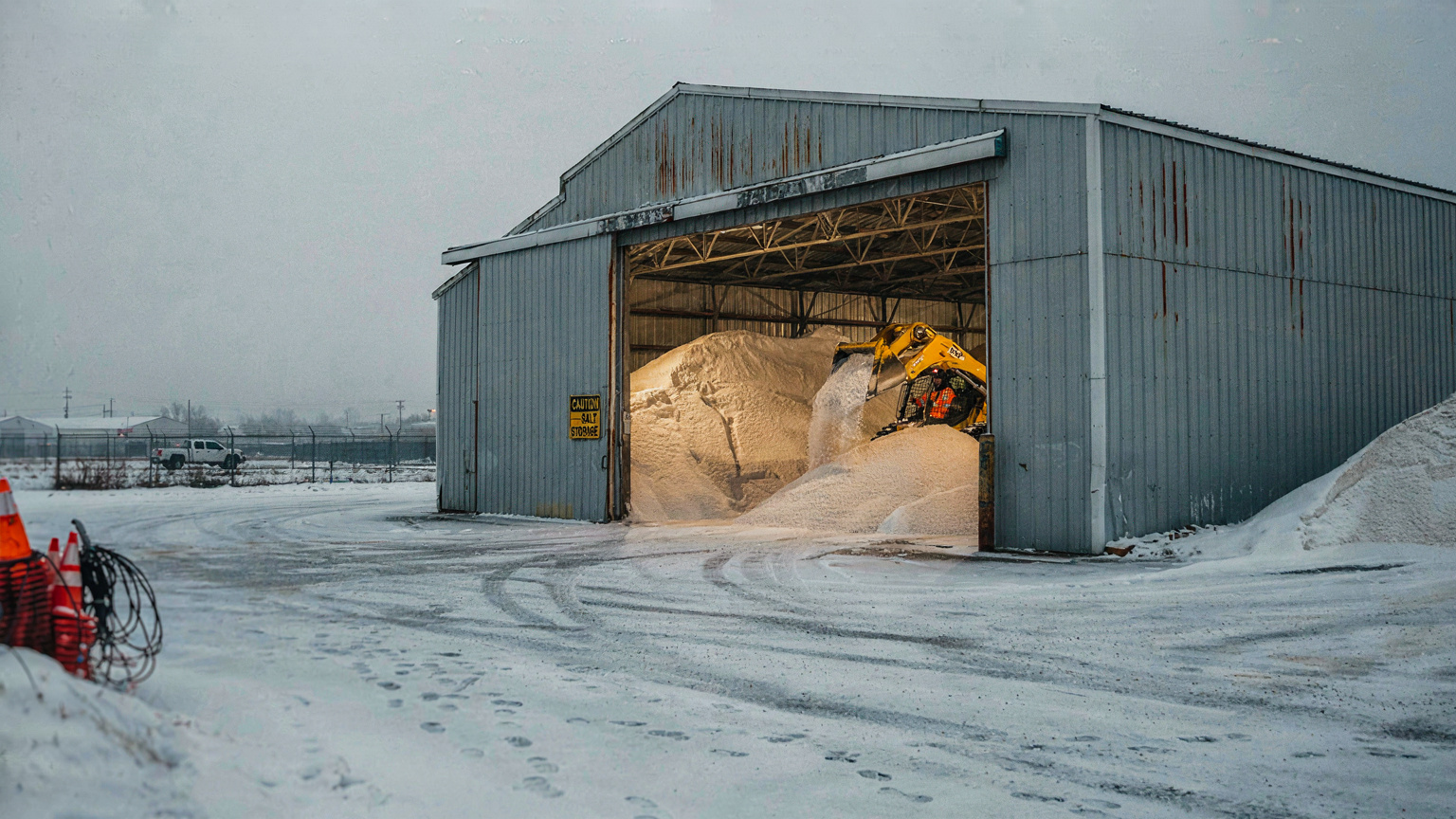
The regional supply picture reinforces the point. Rochester-area television station WHAM reported in December 2025 that American Rock Salt had raised prices for commercial customers by $25 per ton, following a statewide shortage the previous season, and reported in January 2026 that contractors were again raising supply concerns. One Rochester operator interviewed for that coverage had built a salt barn specifically to get ahead of the problem.
A mild winter reduces the tonnage a contractor applies. It does not reduce the price per ton on the material already committed, and it does not refund storage. A per-inch or per-application line that recovers material cost only when material is used leaves the procurement decision unhedged in both directions.
Three ways an August quote goes wrong
Pricing the forecast rather than the distribution. A contractor who discounts a seasonal number because the outlook leans warm has sold the median and kept the tail. If 1982-83 or the January 2016 lake-effect event lands on the route, the discount is paid back with interest during the storm.
Carrying a per-push book into a warm winter. Per-push and per-event structures transfer the weather risk to the client, which protects margin in a heavy season and removes the revenue floor in a light one. In a winter that arrives late and thaws often, a book weighted toward per-push can leave fixed costs uncovered while the equipment sits.
Writing an uncapped seasonal for a site that has no ceiling. Seasonal contracts without a stated accumulation cap oblige unlimited service for fixed money. That obligation is cheap in most winters and ruinous in the one that beats the odds, and the sites where it bites hardest tend to be the ones with the least room to stack snow.
Structures that survive being wrong
The common feature of the structures that hold up is that they stop requiring the forecast to be correct.
SIMA’s own contractor guidance describes the tiered or hybrid seasonal contract as among the least-used tools in the industry. It sets a base seasonal price against a normal range and adjusts outside it. The client pays a predictable monthly figure through the season and settles against the actual accumulation band at the end.
Collars do the same work through contract language rather than tiering. One commercial agreement circulated as a model sets seasonal accumulation thresholds with credits below 24 inches and a surcharge above 72, which bounds the exposure on both sides and gives the client a reason to accept the surcharge clause.
Readiness fees separate the cost of being available from the cost of working. A monthly readiness charge covering insurance, standby labor, and equipment availability recovers the fixed base regardless of accumulation; the variable rate then covers only variable work.
Per-event escalators above a stated depth address the tail directly. A contract that prices normally through a defined band and adds a rate above it converts an unlimited obligation into a bounded one. The threshold is whatever the local record justifies.
None of these are new instruments, and none require a view on El Niño. They require a contractor to know the site well enough to state the bands, which is the work that August is actually for.
Transferring the variance
Parametric weather products pay against a measured index rather than a proven loss, which suits snowfall risk well: the trigger is a station reading, and settlement does not require documenting damage. Zurich markets a construction weather parametric product with triggers that include snow accumulation. The product is built for situations where weather stops work without breaking anything.
Coverage aimed specifically at snow contractors is harder to verify from public sources. Industry advisory and brokerage material circulating in 2026 names Chubb, AXA XL, Munich Re, and Swiss Re as writing parametric snowfall or weather-derivative structures for snow operators, with premiums described in the range of 2 to 5 percent of insured revenue. Those figures come from secondary commentary rather than carrier documentation, and a contractor evaluating the approach should price it directly rather than budget from a published range.
The concept is sound and older than the current market. Exchange-traded snowfall futures were offered on Boston, Chicago, Detroit, Minneapolis, and two New York stations as far back as 2010 and 2011. Airlines and salt suppliers used them as weather insurance. Whether the current products fit an operator’s book is a question for a broker with the contract terms in hand.
The calendar problem
Here is the structural difficulty with quoting in August, and it does not resolve.
SIMA advises contractors to target September 1 as a contract finalization deadline, and to evaluate carefully any contract with fewer than 60 working days of preparation behind it. That benchmark exists for operational reasons: routes have to be built, equipment staged, crews hired, and material ordered before the first event.
CPC’s published long-lead release schedule puts its next seasonal outlooks on September 17 and October 15, both at roughly 8:30 a.m. Eastern on the third Thursday of the month. The next ENSO diagnostic discussion is scheduled for September 10. NOAA’s flagship winter outlook (the annual product carrying the press release and the national maps) has landed in October in each of the last several years.
Every one of those dates falls after the industry’s own finalization benchmark. A contractor who waits for the good forecast misses the operational window; a contractor who hits the window prices on information that will be superseded within six weeks. The calendar guarantees that seasonal contracts are signed on incomplete information, every year, regardless of how confident the signal looks in August.
What to do with the outlook
Use the outlook to set the bands, not the number.
A very strong El Niño is a defensible reason to widen the accumulation range a tiered contract prices against, to push harder for a credit-and-surcharge collar the client will accept while the outlook favors them, and to weight a book toward structures with a revenue floor rather than toward per-push volume. It is not a defensible reason to discount a seasonal price, because the same phase that produced Boston’s 25 percent average reduction also produced the December 1982 storm that deflated a stadium roof.
The signal describes the middle of the distribution. Contracts fail at the edges. An August quote that survives the winter is one written by someone who priced the edges while the asphalt was still hot.
View sources
- NOAA Climate Prediction Center, ENSO Diagnostic Discussion, August 13, 2026.
- NOAA Climate Prediction Center, Long-Lead Forecast Release Schedule for 2026.
- Illinois State Climatologist Office, Illinois State Water Survey, “Impact of El Niño on Snowfall.”
- NOAA Climate.gov, “Snow during El Niños from 1950 to 2009.”
- Minnesota Department of Natural Resources, “Strong El Niño and Winter in the Twin Cities.”
- National Weather Service Cleveland, seasonal snowfall summaries for 1997-98 and 2015-16.
- The Weather Channel, analysis of El Niño impacts on Northeast snowfall.
- Crux Investor, “Salt Prices Rise 9% & Producer Margins Fall 25% Ahead of Bid Season,” August 2026, reporting Compass Minerals fiscal Q3 2026 results.
- WHAM 13, Rochester, reporting on American Rock Salt commercial pricing and regional supply, December 2025 and January 2026.
- Snow & Ice Management Association, “A 52-Week Approach to Smarter Snow & Ice Operations,” on the September 1 finalization benchmark.
- Snow & Ice Management Association, Snow & Ice Resource Center, on tiered seasonal contract structures.
- Zurich North America, Construction Weather Parametric insurance.
- NPR, “Snow Futures: Hedging Bets On The Costs Of Winter,” on exchange-traded snowfall contracts.
Allan Robinson
EditorialThe Snow & Ice America editorial team tests and reviews plows, spreaders, and fleet tools with working contractors across North America. Independent. Never sponsored.
Price your next snow job in 60 seconds.
Estimate per-push, per-inch and seasonal pricing for any lot.