Rock Salt Prices & Supply for Winter 2026–27
Rock salt hit $110–175/ton in 2026 as a major mine closure cut North American supply and dry-bulk freight rates spiked. Here is what contractors need to know about pricing, regional availability, and brine alternatives before winter.
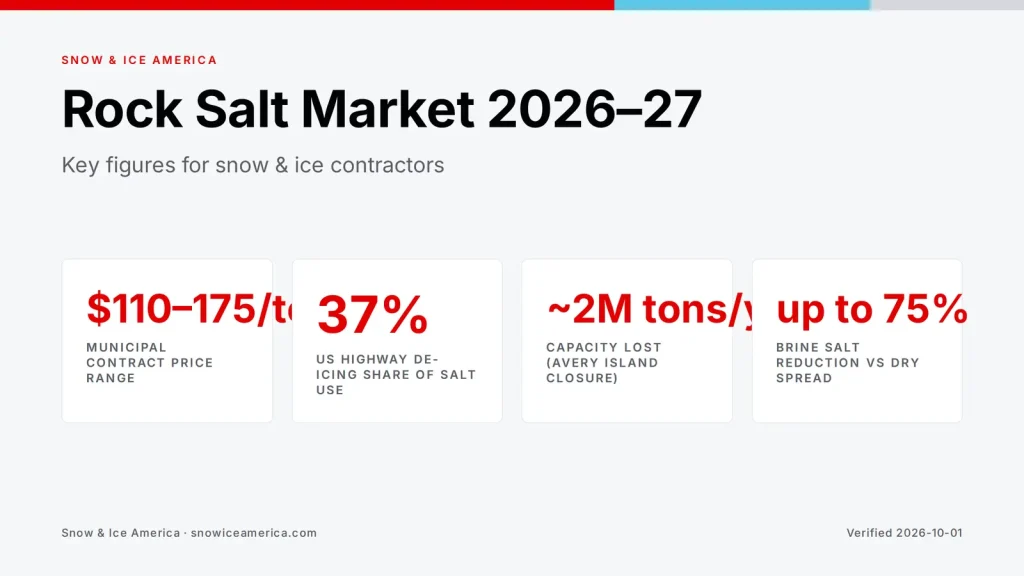
The road salt shortage entered its second consecutive year in 2026, driven by a structural cause — the permanent closure of Cargill’s Avery Island mine in 2024 — that is not reversing. Municipal contract prices now run $110–175 per ton, up from $60–90 two years ago. Contractors who have not locked in supply face spot-market exposure this winter.
Why the shortage is structural, not seasonal
The shortage is structural, not seasonal: the Avery Island mine closure removed approximately 2 million tons per year of domestic production capacity, according to analysis published by Discovery Alert in September 2026. That is not the kind of capacity that recovers quickly; new salt mine development runs five to ten years from exploration to production. The loss is permanent on any planning horizon relevant to this winter.
The USGS Mineral Commodity Summaries 2026 puts US salt production at approximately 40 million tons in 2025, against apparent consumption of about 57 million tons. The 17-million-ton gap has historically been filled by imports from Chile, Egypt, Morocco, and other North African exporters. In 2026, that relief valve largely closed. Dry-bulk freight rates rose 77% over 2025 levels, according to Discovery Alert’s structural market review, pushing landed import costs above what municipal buyers can absorb in fixed-price contracts. The USGS MCS 2025 baseline showed the production-consumption imbalance developing in 2024; the 2026 data confirms it widened rather than corrected.
The procurement record reflects the gap directly. Eighteen Ohio counties received no bids in the first round of 2026 procurement, according to Southwest Regional Publishing. An Illinois state bid went entirely unfilled, Shaw Local reported in September 2026. Highway de-icing accounts for 37% of US salt consumption, according to the USGS — the largest single end-use category and the one with the least flexibility to substitute quickly.
Demand adds pressure on the other side. The 2026–27 El Niño winter forecast calls for above-average snowfall across the Midwest and Northeast — precisely the regions where the 2026 procurement failures have been most acute. A high-use winter against a depleted and expensive supply base is the scenario buyers were warned about in the spring procurement window.
What contractors are paying — regional price data
Contract prices — what contractors are paying across US markets in 2026–27 — vary by region, but the floor has moved up sharply everywhere that has reported. Joliet, Illinois city staff recommended locking in road salt at $117.37 per ton for 2026–27, Citizen Portal AI reported, explicitly citing regional shortages. The Pittsburgh Board of Education paid $152 per ton under its 2025–26 sodium chloride contract, according to the board’s published contract documents. West Virginia municipal buyers reported prices reaching $175 per ton, according to Southwest Regional Publishing. In Ontario — a leading indicator for Great Lakes supply given shared production geography — prices reached approximately $300 CAD per ton, Crux Investor reported, a figure that illustrates the structural direction rather than a US price target.
| Region | Season | $/ton | Source |
|---|---|---|---|
| Joliet, IL | 2026–27 | $117.37 | Citizen Portal AI / city staff report |
| Pittsburgh, PA | 2025–26 | $152.00 | Pittsburgh Board of Education contract |
| West Virginia (state) | 2026 | up to $175 | Southwest Regional Publishing |
| Ontario, Canada | 2026 | ~$300 CAD | Crux Investor |
| Pre-shortage benchmark | 2024 | $60–90 | Discovery Alert |
The $60–90 per ton range that buyers paid in 2024 is the baseline Discovery Alert uses for the before-and-after comparison. At current contract prices the effective increase runs from roughly 30% at the Joliet end to close to 100% for buyers at the West Virginia ceiling. WPXI reported that municipal leaders in western Pennsylvania were warning residents of reduced road salt deployment this winter, with prices approaching double the prior-year level.
Contractors supplying private lots, strata properties, or subcontracts who source independently — rather than through municipal cooperative agreements — face the same floor. Spot-market pricing at a peak demand event will track toward the $175 ceiling. The $110–155 range is the working floor for independent procurement under current conditions, before any event-driven scarcity premium.
When to lock in your order — the bid calendar
Bid timing is now a direct cost variable: the spread between prices locked in during the early procurement window and prices available at the November backup is wide enough to represent a material per-event cost difference, not a rounding adjustment.
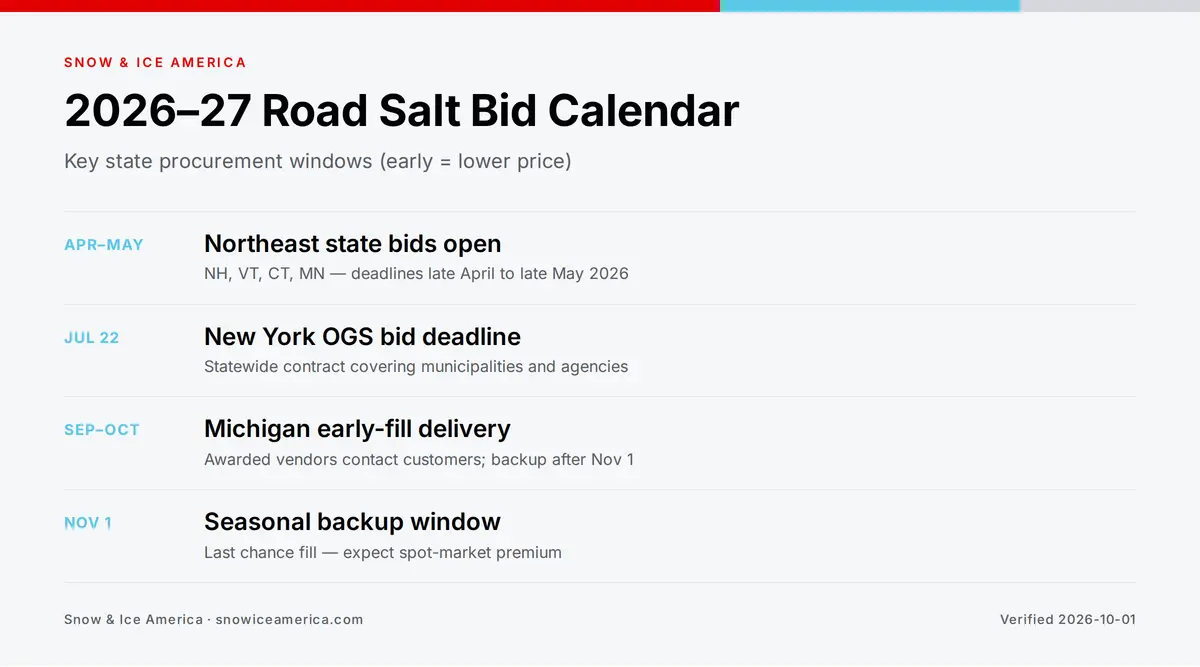
Northeast states — New Hampshire, Vermont, Connecticut, and Minnesota — closed bids in April and May 2026 for September–October delivery. The New York State Office of General Services set a July 22, 2026 deadline for its statewide road salt contract (bid 23449), which covers municipalities and state agencies across New York. Michigan’s MIDEAL extended purchasing program awarded vendors in the spring; those vendors are contacting customers now for early-fill delivery, with a seasonal backup window opening November 1.
Ohio ran a supplemental solicitation — ITB SRC0000039794 — after the first round left 18 counties without an award. That supplemental is the documented outcome of late-cycle procurement, not an edge case.
The pattern across states: each 30 days of delay after a state’s solicitation deadline adds roughly 10–15% to the eventual purchase price, based on the spread between awarded contract prices and reported spot-market figures. The Illinois unfilled bid — and the Joliet staff recommendation that followed — is what late-cycle procurement looks like for a municipality without a cooperative fallback.
Contractors in states with cooperative purchasing programs can access awarded contracts without running a separate RFP. Confirming eligibility and award status before November 1 is the practical action for any contractor whose supply is not yet locked in. What snow contractors should be pricing into 2026–27 bids depends significantly on whether material costs are fixed at contract rates or floating at spot.
Brine and liquid alternatives — the cost case
Liquid brine and blended de-icers offer a direct hedge against both the supply constraint and the per-ton price. Salt brine uses up to 75% less material per lane-mile compared with dry spreading, according to GL Chloride. At current rock salt prices, that reduction translates directly to exposure reduction for any contractor running a tight supply budget this season.
Vermont’s municipal experience quantifies the gain at seasonal scale. A community brine program achieved a 40% reduction in total salt use over a full season, Vermont Public reported in February 2026. The 40% figure is from full seasonal deployment, not a single event.
On production cost, straight sodium chloride brine runs approximately $0.18 per gallon, according to Storm Solutions Plus; adding a corrosion inhibitor pushes the range to $0.18–$2.50 per gallon depending on product. The temperature case for blended liquids is distinct from the price argument. Calcium chloride remains effective to −25°F; rock salt’s practical lower limit is approximately +15°F. Magnesium chloride performs in a similar extended range. In a deep-cold event, a calcium or magnesium blend is not an economic substitution — it is an effectiveness requirement.
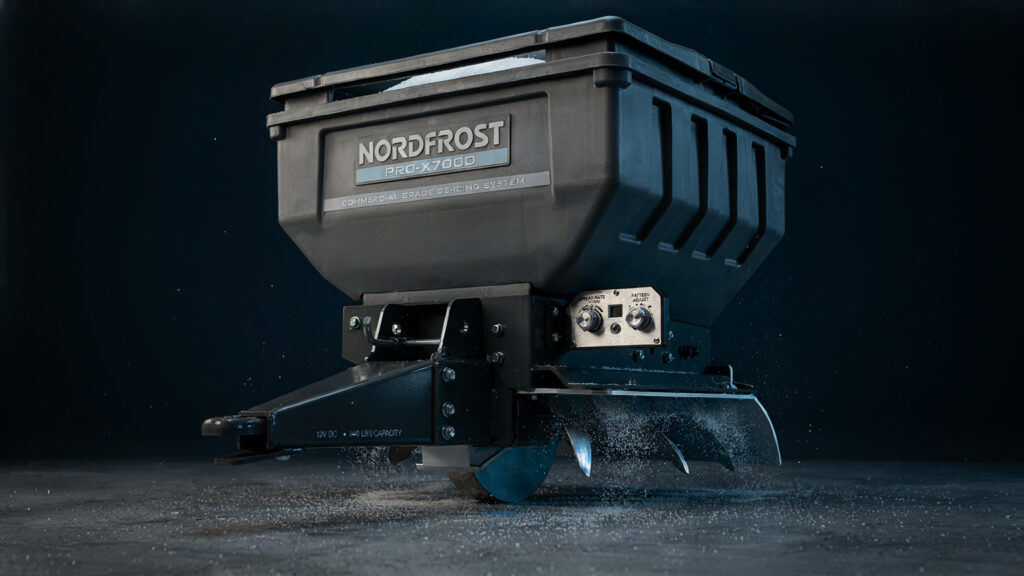
Two constraints apply before treating brine as a complete substitute. Liquid application requires a tank spreader, and a contractor currently running only dry equipment faces a capital outlay rather than a supply swap. And blended liquid product availability is tightening in parallel with the dry salt market; treating brine as an unlimited buffer is an operational error. The full comparison of salt, brine, and sand by temperature and timing covers the application decision in detail.
Kirk Davies
EditorialWith a career spanning over two decades in the snow and ice industry, and former owner of RWB Snow Service Group, Kirk propelled the company to the forefront of the industry while setting new standards for operational excellence and customer service. Kirk's contributions extend beyond his business achievements. He is a respected thought leader who shares his knowledge and insights throughout the snow and ice industry.
Price your next snow job in 60 seconds.
Estimate per-push, per-inch and seasonal pricing for any lot.