V-Plow vs Straight Blade vs Winged Plow: Which Earns Its Spot on the Truck?
The choice between a straight blade, a V-plow and a winged plow is not about which design is "best" — it is about which blade matches the sites a truck actually runs. Here is how the three designs compare on specs, weight, price and the jobs they were built for.

Choosing a V-plow vs straight blade snow plow — or a winged plow — depends on the sites a truck runs. Straight blades handle simple windrow routes at the lowest weight and cost. V-plows cover the widest range of commercial conditions. Winged snow plows move the most snow per pass on large, open lots.
What each blade design does
The three blade types differ in how the moldboard articulates, and that single mechanical distinction drives every other trade-off in weight, price, maintenance and site suitability.
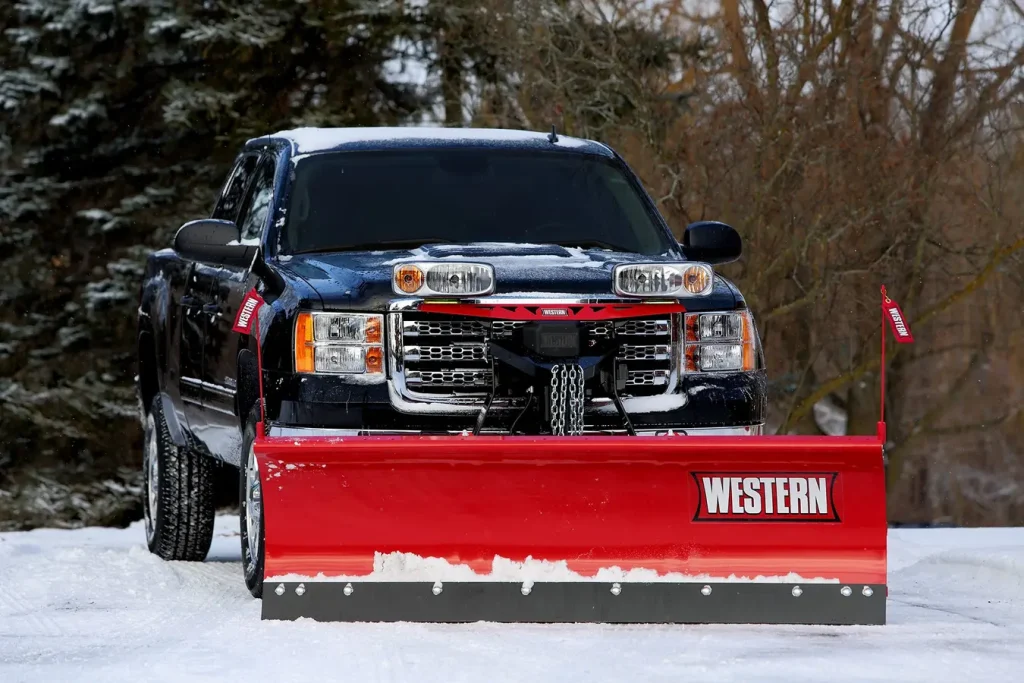
A straight blade is a fixed moldboard that angles left or right on a single pivot. It pushes snow to one side or straight ahead. There is no centre hinge, no wing extension and no scoop position. The Western PRO PLUS, Fisher HD2 and BOSS HTX are representative commercial straight blades in the 7’6″–9′ class.
A V-plow hinges at the centre of the moldboard, giving the operator at least three working positions: a V that splits and throws snow to both sides, a scoop that cups and carries snow forward, and a straight position that mimics a fixed blade. The Western MVP3, Fisher XV2 and BOSS DXT are the flagship commercial V-plows from the three largest North American plow manufacturers. Douglas Dynamics, the parent company of Western Products and Fisher Engineering, produces two of those three lines (Douglas Dynamics, brand overview).
A winged plow — also called an expandable plow — uses hydraulic wings that extend the blade’s effective width by two to three feet on each side. The Western Wide-Out XL expands from 8’6″ to 11′; the Fisher XLS covers the same range; the BOSS EXT extends from 8′ to 10′ (Western Products, Wide-Out XL; BOSS Snowplow, EXT). Wings can typically angle inward to form a scoop position, giving these plows some of the carrying ability of a V-plow without the centre hinge. Sno-Way’s hydraulic-wing models add a proprietary Down Pressure system that applies active downforce during scraping (Sno-Way, hydraulic wing).
Specs and weight across brands
Weight is the specification that most directly limits which truck can carry which blade — and it scales with mechanical complexity. In the 8’6″ class from Western Products alone, the PRO PLUS straight blade weighs 840 lb, stands 31.5″ tall and uses 12-gauge steel; the MVP3 V-plow weighs 940 lb, stands 31″ at the centre and 38″ at the flared ends, and uses 14-gauge steel; the Wide-Out XL winged plow weighs 1,090 lb, stands 31″ tall and also uses 14-gauge steel.
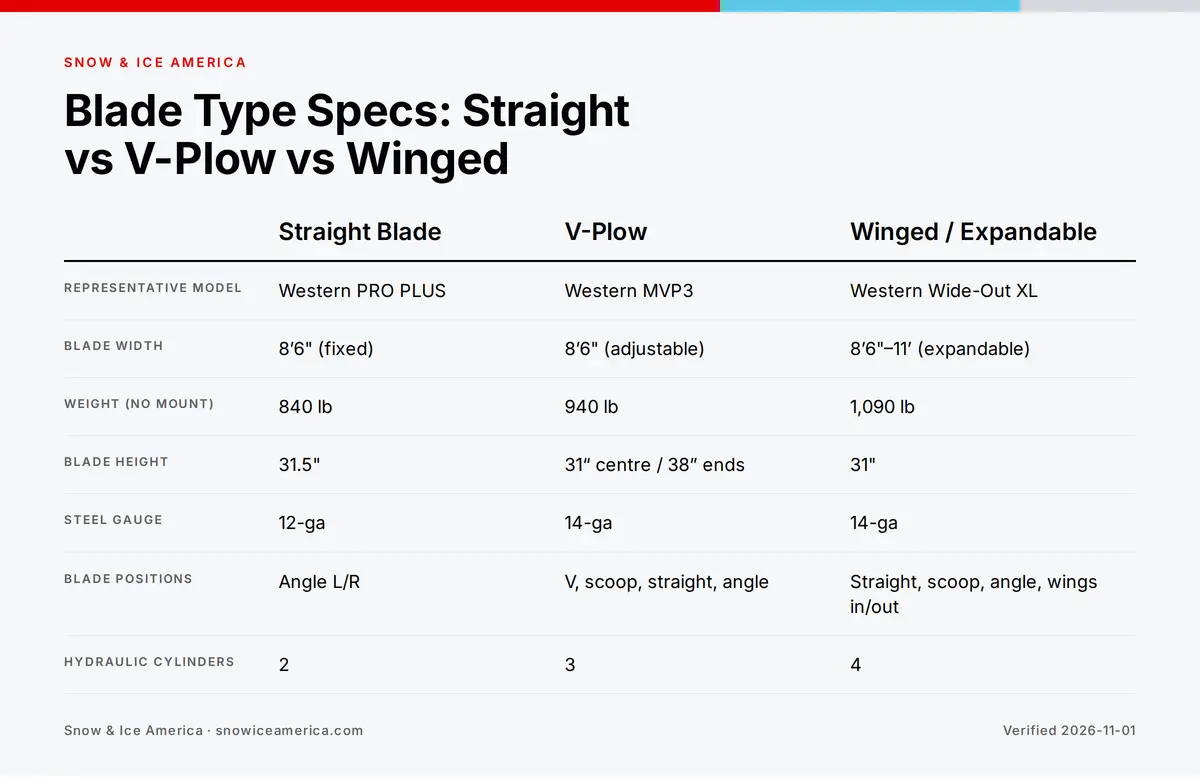
The pattern holds across manufacturers. Meyer Products does not make a winged plow but competes in the straight-blade and V-plow segments with the LOT PRO and Super-V3 respectively. Fisher’s HD2 straight blade (7’6″) weighs 684 lb; the XV2 V-plow (8’6″) weighs 957 lb; the XLS winged plow (8’6″–11′) weighs 1,140 lb (Fisher Engineering, XV2 specs; Fisher Engineering, XLS). BOSS follows the same progression: the DXT V-plow at 8’2″ weighs 868 lb in steel, while the EXT expandable at its retracted 8′ weighs 970 lb (BOSS Snowplow, DXT; BOSS Snowplow, EXT).
Steel gauge varies by design. Straight blades typically use heavier-gauge steel — the Western PRO PLUS runs 12-gauge — because the fixed moldboard absorbs impact across its full width. V-plows and winged plows generally use 14-gauge steel on the moldboard and reinforce the hinge and slide-box areas separately. The BOSS DXT’s 10′ heavy-duty model steps up to 11-gauge, as does the Western MVP3 at 10’6″ (Western Products, MVP3 specs).
Where each design earns its keep
Straight blades, V-plows and winged plows each pay for themselves on different site types — the site mix on a route, not snow depth alone, determines which blade earns its keep.
Straight blades are the default for residential driveways, narrow alleys and straightforward windrow work on roads where the truck pushes in one direction and the snow goes to one side. An operator clearing 30 driveways on a residential route does not need a centre hinge or expandable wings. The lower weight — 100 to 250 lb less than a V-plow of comparable width — also matters on half-ton trucks that sit near their front gross axle weight rating with any commercial plow mounted.
V-plows cover the widest range of commercial site conditions. The V position splits packed drifts and plow berms that a straight blade would ride up on. The scoop position carries snow forward to a pile site instead of windrow-pushing it across the lot. Loading docks, tight turnarounds between parked trailers, and sites that mix open lots with narrow fire lanes all favour a V-plow over a straight blade. For a deeper look at commercial V-plow models, see the BOSS XT plow review and the guide to commercial truck-mounted plows.
Winged and expandable plows move the most snow per pass. Industry sources estimate that the extended wing position carries roughly 30 percent more snow than a straight blade of the same retracted width (Sno-Way). That advantage is decisive on large retail lots, distribution-centre yards and HOA road networks where the truck makes long, uninterrupted pushes. On tight sites or routes that mix lot sizes, the extra width becomes a liability — extended wings do not fit between bollards, and the operator spends time retracting them. For maintenance considerations on expandable plows, see the Western Wide-Out maintenance guide.
Back-dragging — pulling snow away from a garage door, storefront or loading dock by driving forward, dropping the blade and reversing — is a weak point for all three designs. A straight blade applies the most consistent downward pressure across its width because it has no centre hinge, but the difference is modest. Most contractors doing significant back-drag work add a back-drag edge or a dedicated rear plow such as the BOSS Drag Pro regardless of front blade type.
What they cost installed
Installed price — the plow, the mount, the wiring harness and the dealer’s labour — runs higher with each step up in blade complexity.
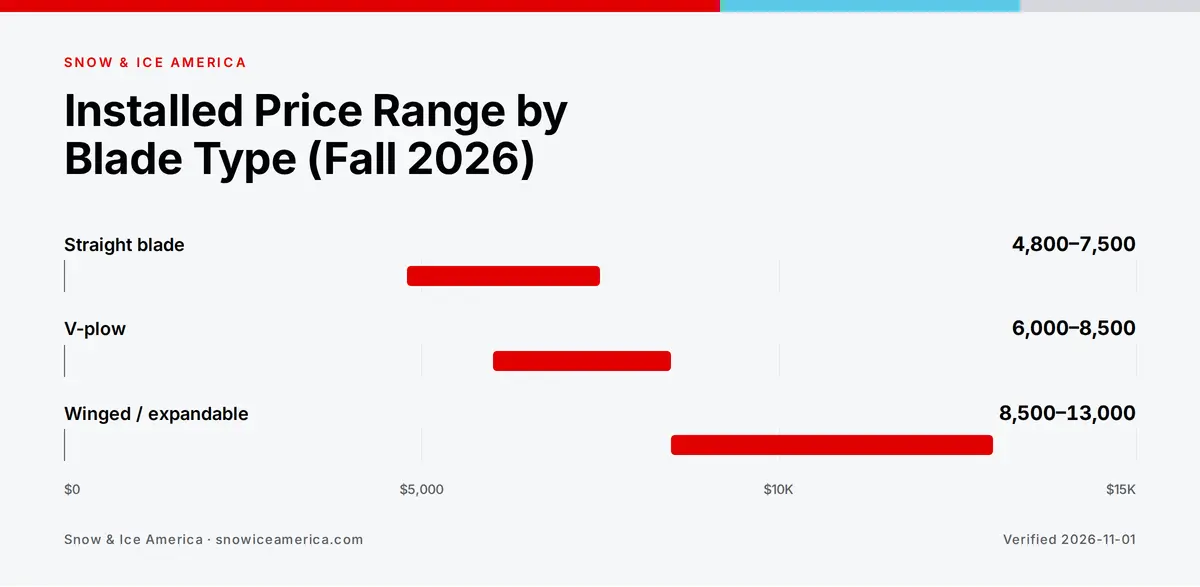
Commercial straight blades in the 8’–9′ class run approximately $4,800–$7,500 installed. V-plows in the 8’6″–9’6″ class run approximately $6,000–$8,500. Winged and expandable plows in the 8’6″-to-11′ class run approximately $8,500–$13,000. The Western Wide-Out XL lists at roughly $11,900–$13,100 depending on headlight package and installation, according to dealer pricing current as of fall 2026 (Stork’s Plows, Wide-Out XL).
The upfront gap narrows when measured per pass. A winged plow that clears an 80,000-square-foot lot in four passes instead of six completes the job faster and frees the truck for the next site. Over a 15-event season, the time saved on a handful of large lots can offset the $2,500–$5,000 price premium over a V-plow.
Maintenance and parts complexity
Maintenance cost tracks the number of moving parts, and moving parts track blade complexity.
A straight blade has two hydraulic cylinders — one for lift, one for angle — and no centre hinge. Pre-season service is a fluid check, a cutting-edge inspection and a trip-spring adjustment. Replacement cutting edges run $80–$150 depending on width and material.
A V-plow adds a third hydraulic cylinder for the centre hinge and introduces a hinge pin that wears under repeated impact. Trip springs or trip-edge assemblies (depending on manufacturer and model) require seasonal inspection. The BOSS DXT’s dual-trip design — a trip-edge and a full-moldboard trip combined — adds parts but reduces the shock transmitted to the truck frame (BOSS Snowplow, DXT). Fluid, hose and seal costs run modestly higher than on a straight blade because of the additional cylinder.
A winged plow replaces the centre hinge with a slide-box mechanism on each wing. The slide boxes use steel-on-steel or polymer wear pads that need periodic replacement. Four hydraulic cylinders (lift, angle, and one per wing) mean more hoses, more seals and more potential leak points. The Western Wide-Out XL’s slide boxes use 3/16″-thick steel construction (Western Products, Wide-Out XL). Pre-season service should include a slide-box inspection, wing-cylinder seal check and wing-alignment verification in addition to the standard fluid and cutting-edge work. For a full seasonal checklist, see the pre-season plow and spreader checklist.
How to match blade to fleet
The decision is driven by the sites on the route, not by a blanket preference for the newest or widest blade.
A one-truck operator running a mixed route — some driveways, some small commercial lots, the occasional loading dock — gets the most flexibility from a V-plow. It handles the widest variety of site conditions without requiring a blade swap, and its installed cost falls in the middle of the three-blade spectrum.
A multi-truck fleet benefits from matching blades to route types. Residential rigs that clear driveways and side streets run straight blades: lighter, cheaper, simpler to maintain and adequate for the work. Commercial rigs assigned to large retail lots or distribution centres run winged plows for throughput. Mixed-route trucks run V-plows. Standardising within a mounting system — Fleet Flex across Western and Fisher equipment, SmartHitch 2 across BOSS equipment — allows blade swaps between trucks when a route changes mid-season.
The dealer question applies here as it does in every commercial snow plow decision: the blade that the nearest capable dealer stocks parts for is worth more on a February morning than the blade with the best spec sheet. A comparison of dealer networks across brands is covered in the Western vs Meyer comparison.
Kirk Davies
EditorialWith a career spanning over two decades in the snow and ice industry, and former owner of RWB Snow Service Group, Kirk propelled the company to the forefront of the industry while setting new standards for operational excellence and customer service. Kirk's contributions extend beyond his business achievements. He is a respected thought leader who shares his knowledge and insights throughout the snow and ice industry.
Price your next snow job in 60 seconds.
Estimate per-push, per-inch and seasonal pricing for any lot.