Western vs Meyer Snow Plows: How to Actually Choose
Western and Meyer are both credible commercial plow brands. The choice between them turns on three questions — which trip design matches your surfaces, what the warranty is actually worth, and whether your nearest dealer stocks service parts for it.
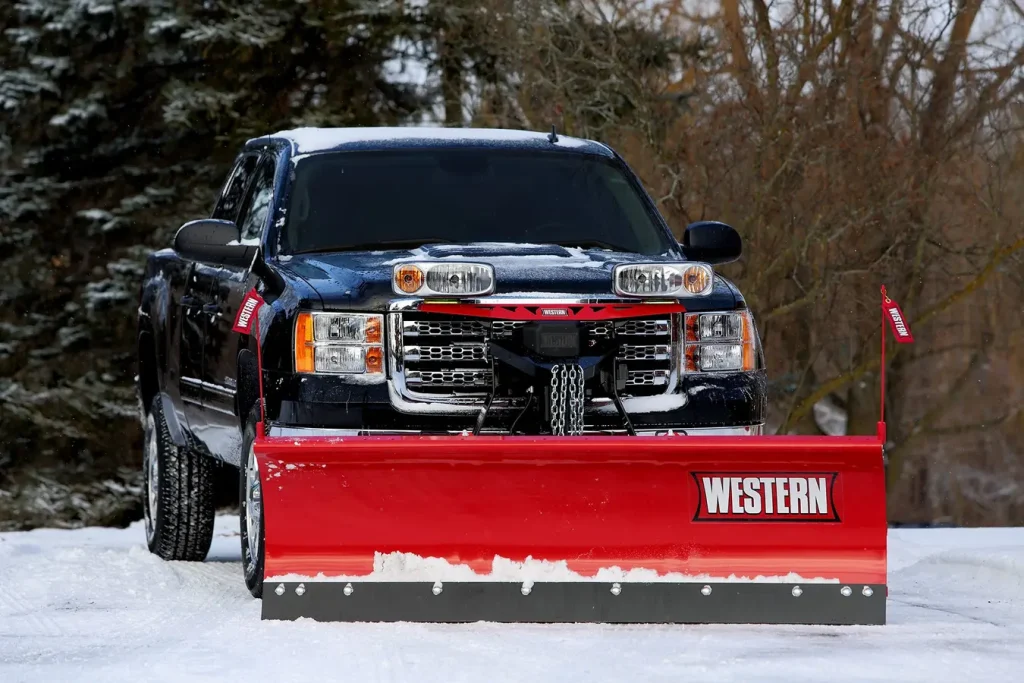
Meyer vs Western is among the most-searched head-to-head plow decisions in the commercial snow removal market, and for most operators the answer will not come from the blade. It will come from which brand your nearest dealer carries service parts for, and from whether the routes being plowed call for a full-trip or a trip-edge design.
The corporate picture, because it explains the lineups
The corporate structure of each brand shapes its lineup, its dealer network, and the parts supply chain behind it. Douglas Dynamics (NYSE: PLOW) is the parent company of five commercial plow and spreader brands: Western, Fisher Engineering, Blizzard Snowplows, SnowEx, and Henderson. Western and Fisher are sibling lines sold through separate dealer networks by territory, which is why a dealer typically carries one and not the other, and why the two brands share mounting-system architecture without being cross-compatible (Douglas Dynamics, brand overview).
Meyer Products is independent: sibling brands, none. The company competes on a narrower truck snow plow range, a five-year limited warranty on its flagship V-plow, and pricing that tends to run slightly below comparable Douglas Dynamics models at street level.
Full lineup, compared
The full lineup comparison favours Western in breadth — it covers more vehicle classes — while Meyer’s lineup is narrower and focused exclusively on truck-mounted equipment.
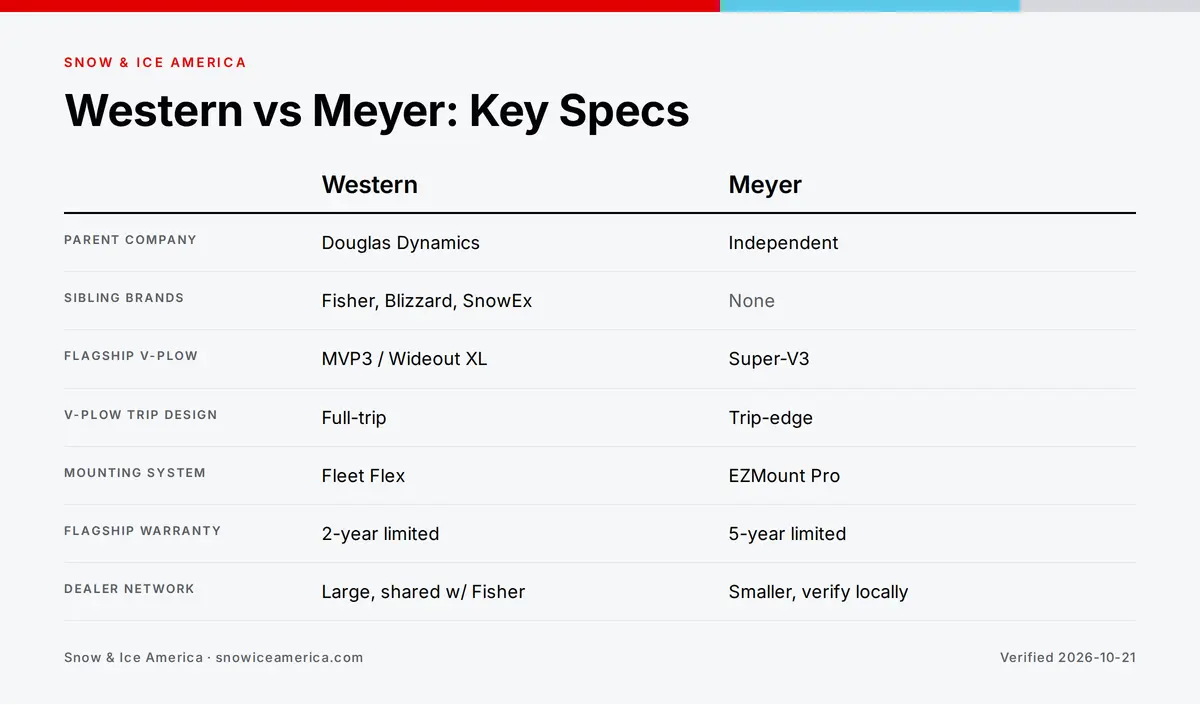
Western’s line runs from the 6’8″ Midweight — rated for 1/2-ton trucks — through the commercial-grade MVP3 and Wideout XL V-plows at the 3/4-ton-and-above end. Western also makes plows for UTVs and compact tractors under the same Fleet Flex electrical architecture. Straight-blade models run approximately $3,800–$4,800 installed; the MVP3 V-plow runs $6,000–$7,500 depending on size and controller, according to dealer price sheets current as of fall 2026.
Meyer’s truck-plow lineup runs from the Drive Pro (6.5’–9′ straight blade, suited to 1/2-ton through 3/4-ton trucks) to the LOT PRO commercial straight blade (7.5’–8.5′, rated for 3/4-ton and above) and the Super-V3 V-plow at the top of the range. Meyer does not make a UTV or compact-equipment plow. Installed prices for the Super-V3 run approximately $5,500–$6,500, according to dealer estimates current as of fall 2026.
Both brands offer expandable-blade models: Western’s Wideout XL stretches from 8’6″ to 11′, and Meyer’s PowerPlow covers a comparable width range for similar truck classes.
Trip mechanism — the specification that changes your season
Trip mechanism is the one specification that materially changes how a plow performs across a full season, and it runs across both brands rather than separating them cleanly.
A full-trip moldboard tips forward entirely on impact with a fixed obstruction — a manhole cover, a buried kerb, a frost heave. The trip spring absorbs the shock; the whole blade comes down. Western’s MVP3 V-plow uses a full-trip design, as does the Wideout XL.
A trip-edge design keeps the moldboard upright on impact and folds only the bottom section back, so the operator loses less momentum and, critically, does not lose the load of snow the blade was carrying. Meyer built the Super-V3 around a trip-edge moldboard specifically so an operator clearing gravel or a surface with obstructions hidden under new snow can take a strike and continue working (Meyer Products, Super-V3; Green Industry Pros).
Paved commercial lots with raised kerbing favour full-trip. Gravel, rural routes, and sites with hidden obstructions favour trip-edge. That distinction does not map cleanly onto brand — Western makes trip-edge models across its straight-blade range — but the Super-V3’s trip-edge moldboard is the primary technical argument for it over the MVP3 in the right application. For a broader treatment of trip-mechanism trade-offs, see the guide to commercial truck plows.
Mounting and electrical
Mounting and electrical systems are where the two brands diverge most sharply in terms of equipment ecosystem. Western uses Fleet Flex, a quick-connect headlamp and hydraulic coupling that allows a single controller to run any Fleet Flex-compatible plow or spreader in the Douglas Dynamics family. A truck wired for Fleet Flex can add a Western, Fisher, SnowEx or Blizzard unit without rewiring, which simplifies mixed-equipment decisions on a multi-truck fleet (Western Products, Fleet Flex overview).
Meyer uses EZMount Pro, its own quick-connect frame system. EZMount Pro is specific to Meyer equipment and does not cross-mount to Fleet Flex hardware. Adding a Meyer plow to a truck already wired for Western or Fisher requires a separate wiring kit.
Neither system has a meaningful reliability advantage over the other in practice. The difference is ecosystem: a Fleet Flex truck stays within the Douglas Dynamics family; an EZMount Pro truck stays in Meyer’s.
Warranty
Meyer’s five-year limited warranty on the Super-V3 is the most visible differentiator in this segment, where a two-year limited term is the more common offering. Western’s warranty varies by model; most Western plows carry a two-year limited term, according to current Western product documentation (Western Products warranty).
The practical value of a longer warranty depends on two things the warranty document does not name: the proximity of an authorized service dealer and that dealer’s turnaround on warranty claims. A five-year warranty served by a dealer three hours away is of limited use during a multi-day event.
The question that should decide it
The most important question in a Western vs Meyer decision is which brand the nearest capable dealer services — not which they can order. A commercial plow is a hydraulic and electrical system that will fail at an inconvenient time; the practical difference between the two brands on a February morning is whether the solenoid in question is forty minutes away or four days away.
Western’s larger network — shared by territory with Fisher — makes that calculus easier in most of the snow belt. Meyer’s dealer network is smaller and coverage varies by region; verify local availability before committing. The site’s state-by-state dealer guide lists what to ask when vetting a service dealer. For pricing context on installed commercial plows, see the snow plow cost overview.
Kirk Davies
EditorialWith a career spanning over two decades in the snow and ice industry, and former owner of RWB Snow Service Group, Kirk propelled the company to the forefront of the industry while setting new standards for operational excellence and customer service. Kirk's contributions extend beyond his business achievements. He is a respected thought leader who shares his knowledge and insights throughout the snow and ice industry.
Price your next snow job in 60 seconds.
Estimate per-push, per-inch and seasonal pricing for any lot.