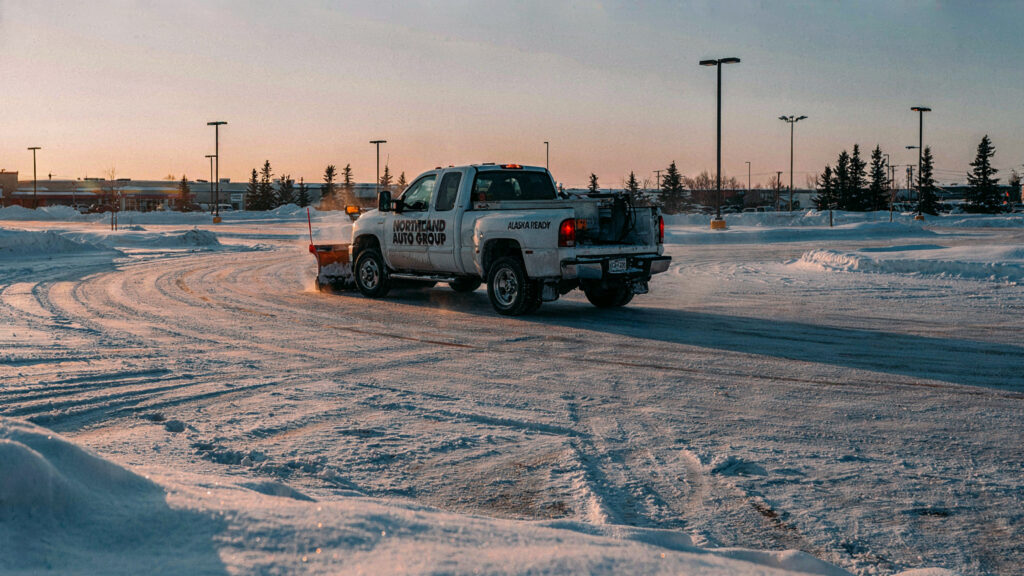
Best Commercial Snow Plows: Matching Blade to Truck
Commercial snow plow selection starts with the front axle, not the catalogue. Here is how to read your truck's limits, match them to a blade type, and choose the right V-plow for a 3/4-ton or 1-ton commercial fleet.
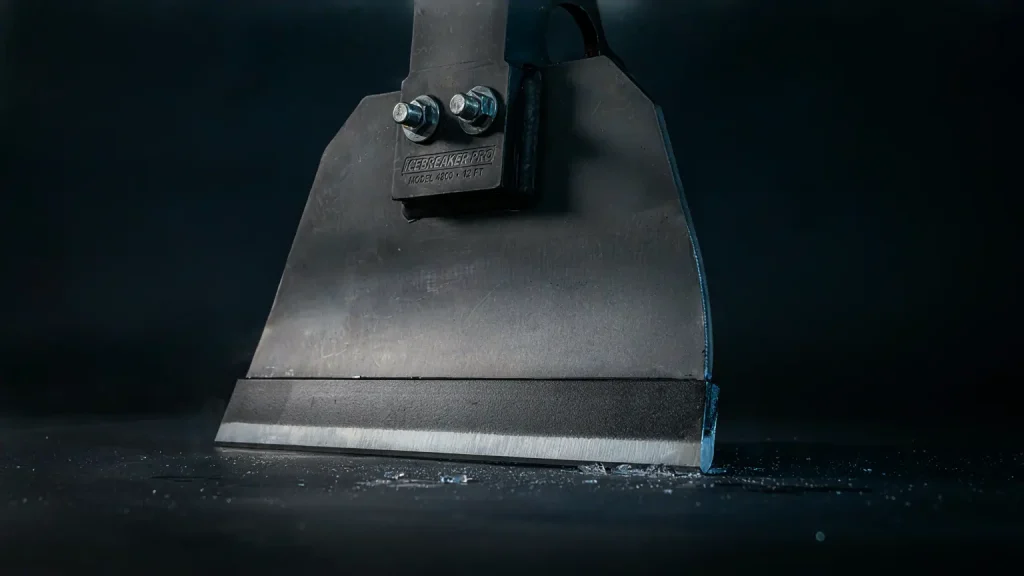
Choosing a commercial snow plow comes down to one number before any brand: the truck’s front gross axle weight rating (FGAWR). That number is set by the manufacturer, it governs what the front axle can carry, and no catalogue selection changes it. Get the truck side right first and the blade decision becomes much more straightforward.
The truck decides first: FGAWR and plow prep
FGAWR and the plow prep package are the two specifications that govern every commercial snow plow decision.
Front Gross Axle Weight Rating (FGAWR) is the manufacturer’s limit on what the front axle may carry. A plow hangs entirely ahead of that axle, so its full weight counts against the limit with the leverage of that overhang. Exceeding FGAWR is not a warranty technicality — it changes braking, steering and how the truck responds on ice, and it will be examined after any collision.
The snow plow prep package is the second requirement. Per Cars.com, it typically bundles a higher-output alternator, plow-control wiring, a transmission oil cooler and heavier front suspension. A plow draws serious current every time it lifts and angles; without the alternator upgrade you will cycle through batteries, and without the cooler you are heating the transmission through every push.
Truck class, honestly
| Truck | Realistic use | The catch |
|---|---|---|
| Half-ton (F-150, Ram 1500) | Own driveway, a few neighbours, light residential | Regular commercial use brings accelerated front-end wear, faster brake wear and higher transmission failure rates |
| Three-quarter-ton (F-250, 2500) | The commercial baseline — residential routes and small lots | Requires the prep package to be worth running |
| One-ton (F-350, 3500) | Heavy commercial, wide blades, V-plows and wings | Higher purchase and running cost; overkill for driveway work |
The half-ton wear note is not manufacturer caution — fleet guidance for 2026 is explicit that regular commercial plowing on a half-ton accelerates front-end, brake and transmission wear. A half-ton with plow prep is a legitimate light-duty machine for residential work. What it is not is a commercial route truck, and treating it as one is expensive in a way that shows up in year two rather than year one.
Blade types and when to use them
Four categories of blade cover the commercial range, and the right one depends on the surface, lot size and whether the site has tight approaches.
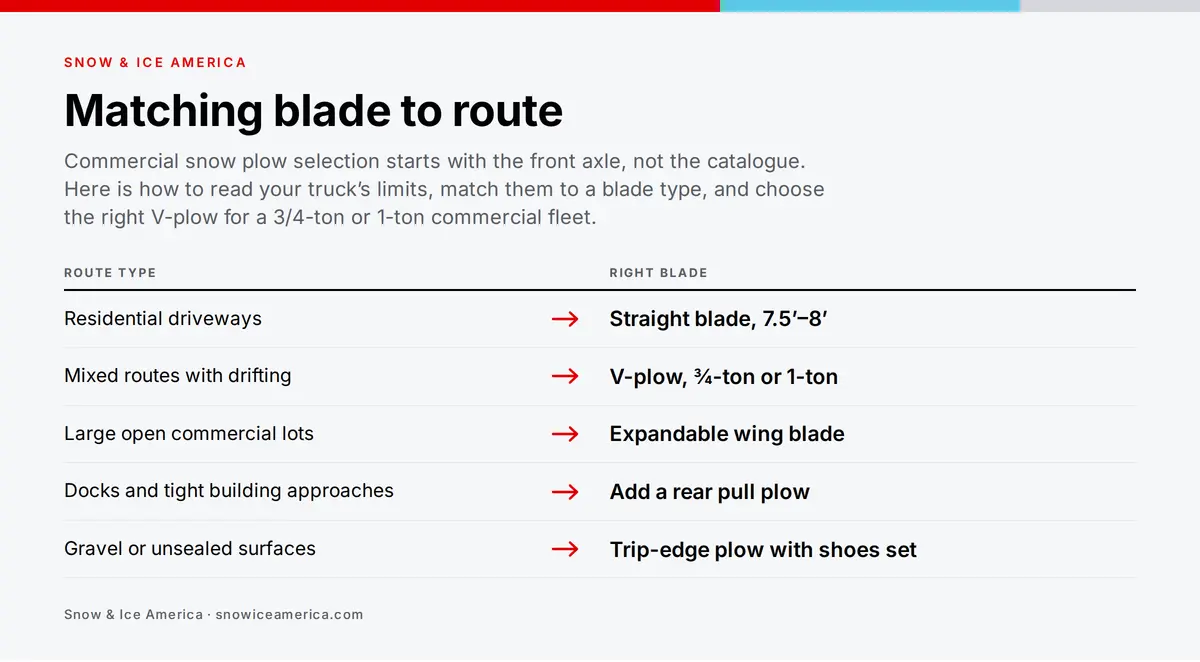
Straight blade is the simplest and lightest. Its strength is back-dragging; its weakness is that snow spills off the ends on anything but short pushes. On a route that is mainly residential driveways, a straight blade on a three-quarter-ton is the right tool.
V-plow works in three positions: V (breaking through drifts and windrows), straight (standard pushing) and scoop (carrying snow across an open lot). The V position earns its premium on mixed routes where at least one site per event has a substantial drift or hard windrow. On uniformly open lots without these obstacles, an expandable straight blade moves more snow per pass for less money.
Expandable wing blade extends from a straight-blade centre section to a wider span — Western’s Wideout XL stretches from 8’6″ to 11′, for example. The wider pass reduces laps on large lots. The extra width adds weight, so check the front axle limit before spec’ing one; the width also becomes a liability on lots with narrow entry points or obstacles.
Rear pull plow back-drags loading docks, tight building approaches and garage doors — the one task a front blade does badly. A rear plow supplements a front blade rather than replacing it. Sites that combine open lot area with tight loading approaches typically warrant both.
V-plow models for three-quarter-ton and one-ton trucks
The four commercial V-plow lines that account for the majority of North American truck installations are the Boss V-XT, Fisher XV2, Western MVP3 and Meyer Super-V3. All four are rated for three-quarter-ton through one-ton trucks. The choice between them rests primarily on trip design, your truck’s mounting ecosystem and dealer proximity.
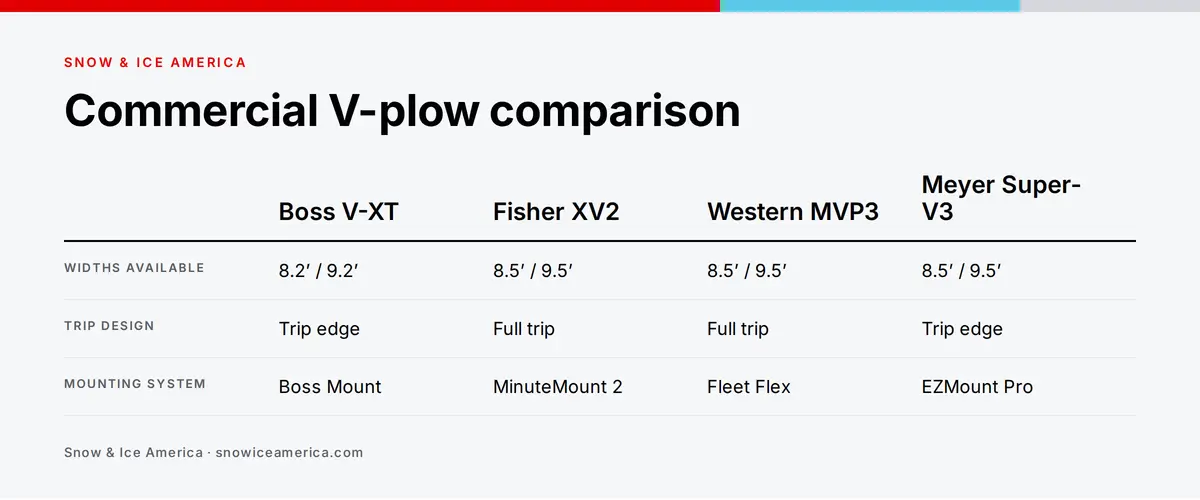
Boss V-XT is available in 8.2′ and 9.2′ widths and uses a trip-edge design: the moldboard stays upright on impact and only the lower section folds back. This makes the V-XT well suited to mixed surfaces where operators encounter occasional rock strikes or hidden obstructions. The V-XT uses BOSS’s own quick-attach mounting and SmartTouch 2 in-cab controller (BOSS Products, V-XT).
Fisher XV2 comes in 8.5′ and 9.5′ widths and uses a full-trip moldboard: the entire blade tips forward on impact, absorbs the shock, then resets. Fisher’s MinuteMount 2 quick-attach and Insta-Act hydraulic system are standard. The XV2 is available in steel, stainless and poly moldboard options — a stainless or poly version can reduce weight on a truck near its front axle limit (Fisher Engineering, XV2).
Western MVP3 runs 8.5′ and 9.5′ and also uses a full-trip design. Western and Fisher share a corporate parent, Douglas Dynamics, and the MVP3 and XV2 share engineering lineage; the primary practical differences are mounting systems and dealer territory. Western uses Fleet Flex, which is also compatible with the Douglas Dynamics spreader and wing line, making it straightforward to run mixed equipment from a single truck wiring harness. Installed prices run approximately $6,000–$7,500 (Western Products, MVP3).
Meyer Super-V3 is available in 8.5′ and 9.5′ and, like the Boss V-XT, uses a trip-edge moldboard — the main technical reason to choose it over the MVP3 on gravel routes or any surface with hidden obstructions. Meyer uses EZMount Pro, a quick-attach system specific to Meyer equipment that does not cross over to Fleet Flex hardware. The Super-V3 carries a five-year limited warranty where most competitors offer two years; the value of that warranty depends on local dealer proximity. Installed prices run approximately $5,500–$6,500 (Meyer Products, Super-V3).
For a detailed comparison of Western and Meyer — including dealer network coverage and how the trip designs play out across route types — see the Western vs Meyer snow plow comparison.
Trip mechanism: the decision nobody explains
Trip mechanism — how a commercial snow plow survives hitting something immovable — is the specification most buyers skip, and matching the wrong design to your surfaces costs you either lost loads or mid-event downtime. There are two designs, and matching the wrong one to your surfaces costs you either lost loads or unexpected downtime. BOSS Products places it near the top of its buying guidance for a reason.
| Full trip | Trip edge | |
|---|---|---|
| What moves | The entire moldboard trips forward | The blade stays upright; only the bottom edge trips back |
| On impact | Rolls over the obstruction; shock largely absorbed | Edge folds back, blade keeps its position |
| Snow load | Dumps the blade’s load when it trips | Retains the load — you keep plowing |
| Suits | Paved lots with kerbs and raised edges | Gravel and surfaces with unseen obstructions |
The practical difference is clearest on gravel. A trip-edge plow can clip a buried rock and carry on — the edge folds back and resets while the load stays on the blade. A full-trip plow dumps the blade load on every strike and sends the operator back to recover it. On a paved lot with kerbing, the reverse is true: the full-trip’s rolling action transmits less shock to the truck’s front end, and there is no loose material to leave behind.
Blade material
Three materials cover the commercial range, each with a different trade-off on weight, cost and durability.
- Powder-coated steel — the default across all four V-plow lines. Strongest and cheapest to replace; rusts at every scrape through the coating.
- Stainless steel — corrosion-resistant and sheds wet snow more readily, which matters on heavy, sticky events. Costs more upfront.
- Poly — lightest of the three, which means it takes less off the FGAWR budget. Sheds snow best. Less rigid and more vulnerable to gouging on rough surfaces.
On a truck already near its front axle limit, a poly or stainless moldboard is a practical way to buy blade width that the default steel version would put over the limit.
A plow truck pre-season checklist covers what to inspect on the blade, cutting edge, and mounting system before the season starts — worn components found in October are a short job; the same components found mid-event are a tow and a lost shift.
Matching the plow to your route
Route profile shapes the equipment decision more than brand loyalty does. See the snow plow cost guide for price ranges by truck class and blade type.
- Residential driveways — straight blade, 7’6″ to 8′, on a three-quarter-ton. Back-drag capability matters more than width here.
- Mixed residential and small commercial — V-plow on a three-quarter or one-ton. The scoop position pays for itself on the first heavy event with drifting.
- Large open lots — expandable wing blade, or a straight blade paired with a pusher box on a loader for maximum efficiency.
- Sites with docks and tight buildings — add a rear pull plow; pushing snow away from a building is the task a front blade does badly.
- Gravel routes — trip-edge design, and set your shoes to carry the blade just clear of the surface.
- Contracts with trigger-depth guarantees — a V-plow on a one-ton gives the most operational flexibility across weather types and allows the operator to respond at trigger regardless of conditions.
For a breakdown of how equipment choices interact with contract structure, see seasonal vs per-push snow contracts.
Kirk Davies
EditorialWith a career spanning over two decades in the snow and ice industry, and former owner of RWB Snow Service Group, Kirk propelled the company to the forefront of the industry while setting new standards for operational excellence and customer service. Kirk's contributions extend beyond his business achievements. He is a respected thought leader who shares his knowledge and insights throughout the snow and ice industry.
Price your next snow job in 60 seconds.
Estimate per-push, per-inch and seasonal pricing for any lot.