Commercial Snow Removal Pricing: How to Estimate Per Push, Per Inch, or Per Season
Commercial snow removal pricing typically falls into four models — per push, per inch, seasonal, and time-and-materials — each shifting the weather risk differently between contractor and client. Here is what each model costs, how to calculate a price from your own numbers, and which contract structure fits which site.

Commercial snow removal pricing usually comes down to four models: per push, per inch, seasonal, and time-and-materials. Rates range from $75 per event for a small lot to $20,000 or more per season for a large commercial property. The real question behind every model is who carries the weather risk — you or the client.
This article breaks down each pricing model with current rate ranges, explains how to build a price from your own costs, and covers the site-specific factors that move the number up or down.
How commercial snow removal pricing works
Every commercial snow removal contract answers one question first: who pays more when the winter is heavier than expected? The pricing model you choose determines that answer.
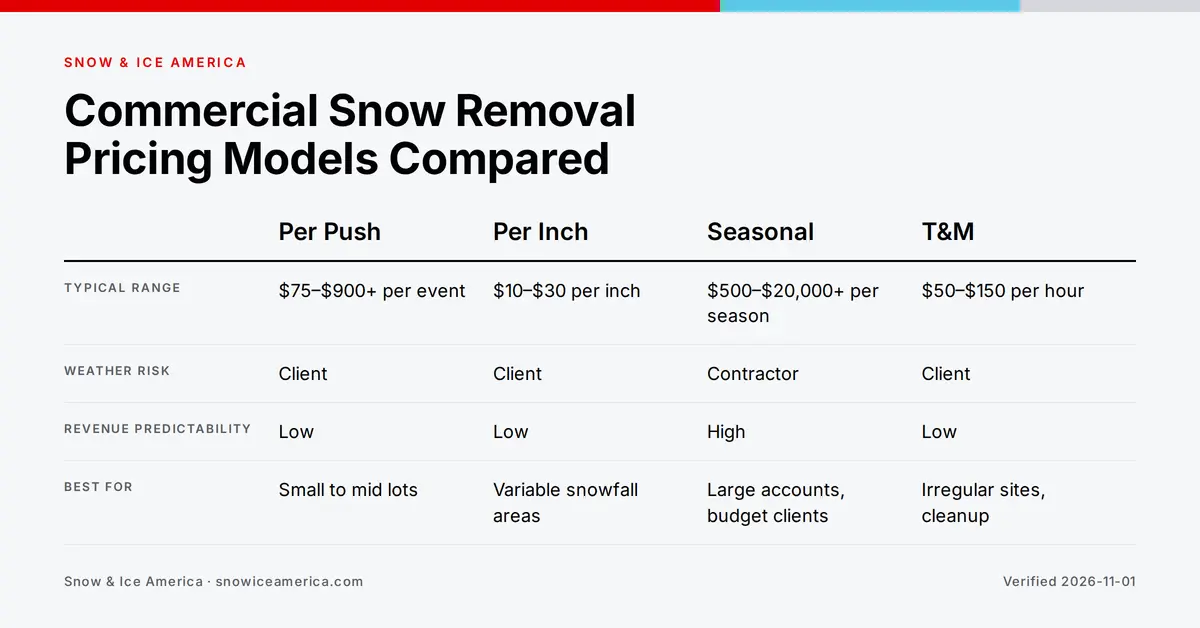
Per-push and per-inch contracts pass the weather risk to the client. You get paid for every event or every inch that falls, so a heavy winter means more revenue. Seasonal contracts reverse the arrangement. The client pays a flat fee for the entire season, and you absorb the cost of extra events if the snow keeps coming.
There is no single best model. The right one depends on the lot size, the local snowfall pattern, the client’s budget preference, and how much risk you are willing to carry. Most contractors use more than one model across their route, matching each contract to the site.
Per-push pricing
Per-push pricing, also called per-event pricing, charges the client a flat rate each time you clear the lot. The contract specifies a trigger depth, usually 1 or 2 inches, and you deploy once accumulation reaches that threshold.
Rate ranges vary by lot size. For lots under 10,000 square feet, expect $75 to $200 per push. Mid-size lots of 10,000 to 50,000 square feet typically run $200 to $500. Lots over 50,000 square feet can reach $600 to $900 or more per event, depending on obstacles, staging, and access.
The trigger depth matters more than most contractors realize. A 1-inch trigger is standard for high-traffic commercial sites such as retail centers and medical facilities, where slip-and-fall liability is high. A 2-inch trigger suits lower-traffic industrial sites and cuts the number of seasonal rollouts by roughly 28 percent. Put the trigger depth in the contract in writing. Late arrivals and missed triggers are the most common source of disputes.
Per-push pricing works well for smaller lots and in regions where snowfall is unpredictable. The client pays only when you work. The downside is that your revenue swings with the weather. A light winter means fewer pushes and less income.
Per-inch pricing
Per-inch pricing ties the rate to the actual depth of snowfall. You measure accumulation at the site, and the client pays a set amount per inch. Many contractors use a tiered structure: a base rate for the first 6 inches and a higher rate for each inch beyond that.
Typical per-inch rates for commercial properties range from $10 to $30 per inch for the first 6 inches, then $5 to $10 per inch above that threshold. The wide range reflects lot size, equipment type, and regional labor costs.
Depth measurement needs to be consistent and documented. Take readings at several points across the lot before and after each event, because accumulation varies even within a single property. Note the readings in your service log. If a dispute arises, those records are your defense.
Per-inch pricing gives the client a clear link between what fell and what they pay. It works best in areas with highly variable snowfall where a flat per-push rate might underprice a heavy event or overprice a dusting. The trade-off is that measurement adds time to each event, and the client may question your readings.
Seasonal contracts
A seasonal contract charges the client a flat fee for the entire winter, regardless of how many events occur. The client gets predictable monthly payments. You get guaranteed revenue. The catch is that you carry all of the weather risk.
Seasonal rates depend on the lot size, the scope of services, and the region’s snowfall history. Small commercial lots under 10,000 square feet typically range from $500 to $2,500 per season. Mid-size lots run $2,500 to $7,000. Large properties over 50,000 square feet can reach $10,000 to $20,000 or more, especially in high-snowfall areas where the contract includes salting and ice management.
To calculate a seasonal price from your per-push numbers, divide the area’s average annual snowfall by the average inches per event to get an expected event count. Multiply by your per-event cost, then add a risk margin for the possibility of a heavier-than-average winter. If your area averages 45 inches per year and events average 3 inches, that is 15 events. At $300 per event, the base is $4,500. Most contractors add 10 to 20 percent on top to cover the risk.
The Snow & Ice Management Association (SIMA) publishes SIMA-10-2025, a standard practice for procuring and planning snow and ice management services. It recommends that contracts be awarded no later than September 1 and suggests a minimum one-year term with cancellation clauses for both sides. Reading it before you write your first seasonal contract is worth the time.
Seasonal contracts suit large accounts where the volume justifies the risk and clients who need budget certainty. They do not suit contractors who cannot absorb a high-event season without losing money.
Time-and-materials pricing
Time-and-materials pricing charges by the hour for labor and equipment, plus the actual cost of materials used. Hourly rates for commercial plowing typically fall between $50 and $150, depending on the equipment. A pickup with a plow sits at the lower end. A wheel loader or skid steer with a pusher box commands the higher end.
This model works for irregular jobs: one-off cleanups after a major storm, sites with unusual layouts that are hard to bid flat, or ice-only events where the scope is unpredictable. It is also common as a fallback clause in per-push or seasonal contracts for work that falls outside the agreed scope, such as snow hauling or relocation when staging areas fill up.
The downside is that the client has less cost certainty, and you need to track hours and material use carefully. Document the start and end time for each truck and each material application. A service documentation workflow protects both sides.
How to estimate a commercial snow removal price
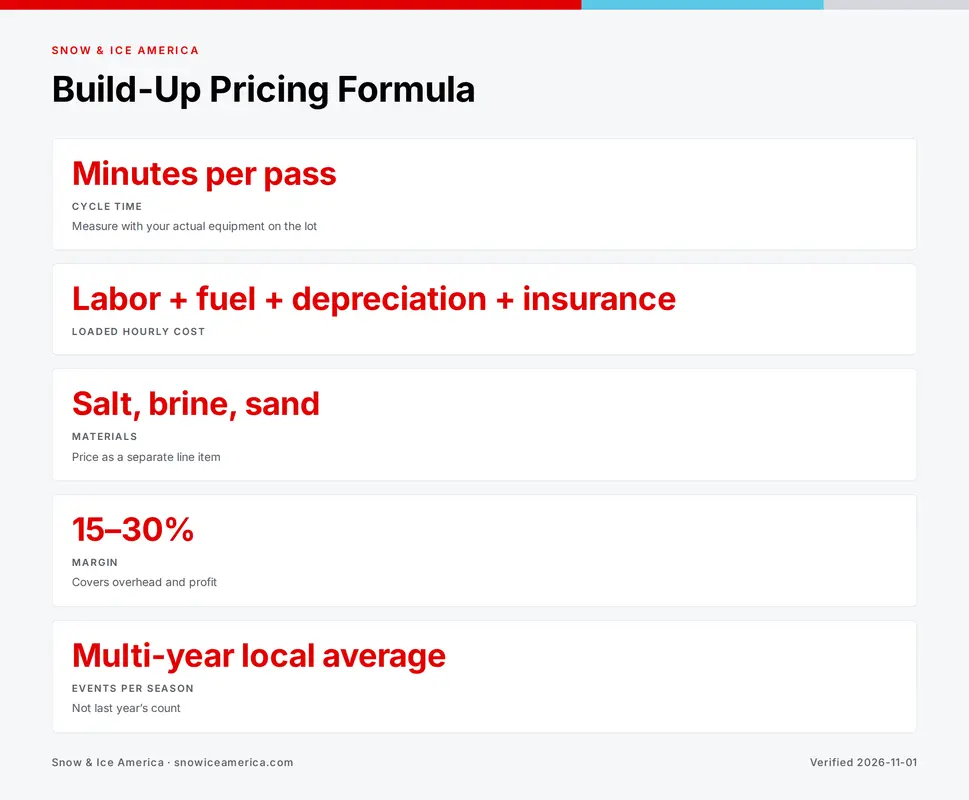
The build-up formula used by most commercial contractors starts with the site itself. Measure the plowable pavement, the sidewalks, and any dock or loading areas separately. Calculate your single-pass cycle time in minutes per pass using your actual equipment on the lot, not an estimate from a satellite photo.
The formula is: cycle time per event multiplied by your fully loaded hourly cost, plus materials such as salt, brine, and sand, plus your target margin, multiplied by expected events per season.
Your fully loaded hourly cost includes labor, fuel, equipment depreciation, and insurance. Leave any of those out and you are underpricing the job.
As a sanity check, divide your per-event price by the lot’s square footage. The result should fall roughly between $0.01 and $0.05 per square foot per push for plowing alone. If it comes in well below that range, re-check your cycle time or your loaded cost. If it comes in well above, the lot may have complexity that justifies the premium, but make sure you can explain it to the client.
Site-specific factors that move the price include slopes that require extra passes, obstacles such as islands and bollards that reduce plow efficiency, limited snow staging areas that may require mid-season hauling, restricted clearing hours that compress your route, and decorative surfaces that limit your choice of cutting edge or de-icer.
Choosing the right pricing model
The pricing model you offer should match the site and the client’s priorities. Consider four factors.
Lot size is the simplest. Smaller lots under 10,000 square feet are usually straightforward enough for per-push pricing. Larger lots with higher total spend are where seasonal contracts make sense, because the volume gives you enough margin to absorb the weather risk.
Snowfall variability matters. In areas where annual totals swing widely year to year, per-push or per-inch pricing protects your revenue in heavy winters. In areas with consistent snowfall, seasonal pricing is easier to calculate and the risk is more manageable. Regional snowfall trends are shifting contract structures across the industry.
Client budget preference is worth asking about directly. Some property managers want a fixed monthly number they can plug into a budget. Others prefer to pay as they go. The model that matches their preference is the one most likely to close.
Your own risk tolerance is the final factor. If you are a newer contractor still building cash reserves, per-push pricing keeps your exposure low. If you have the financial depth to absorb a 30-event season when you priced for 20, seasonal contracts offer higher margins over a multi-year average. Winning more contracts often comes down to offering the model the client wants without taking on risk you cannot cover.
Many contractors use a hybrid approach. A per-push base rate with an added fee if snowfall exceeds a set threshold combines the predictability of per-push with protection against unusually heavy events. Others offer per-push for plowing and a separate per-application charge for salt, keeping material cost fluctuations out of the plowing rate.
Whatever model you choose, put the terms in writing. The contract should specify the trigger depth, the scope of work, the response time, the payment schedule, and what happens when conditions fall outside the agreed scope. A clear contract is worth more than a clever pricing formula.
Kirk Davies
EditorialWith a career spanning over two decades in the snow and ice industry, and former owner of RWB Snow Service Group, Kirk propelled the company to the forefront of the industry while setting new standards for operational excellence and customer service. Kirk's contributions extend beyond his business achievements. He is a respected thought leader who shares his knowledge and insights throughout the snow and ice industry.
Price your next snow job in 60 seconds.
Estimate per-push, per-inch and seasonal pricing for any lot.