BOSS AutoSpread vs. Western/Fisher/SnowEx Auto Speed Control: Which Rate Controller Pays Back Faster?
Two GPS-linked rate controllers now let hopper spreaders match material flow to truck speed automatically. One ships on new BOSS spreaders, the other retrofits any Fleet Flex unit back to 2016. Here is what each system does, what it costs, and how fast rising salt prices pay the upgrade back.
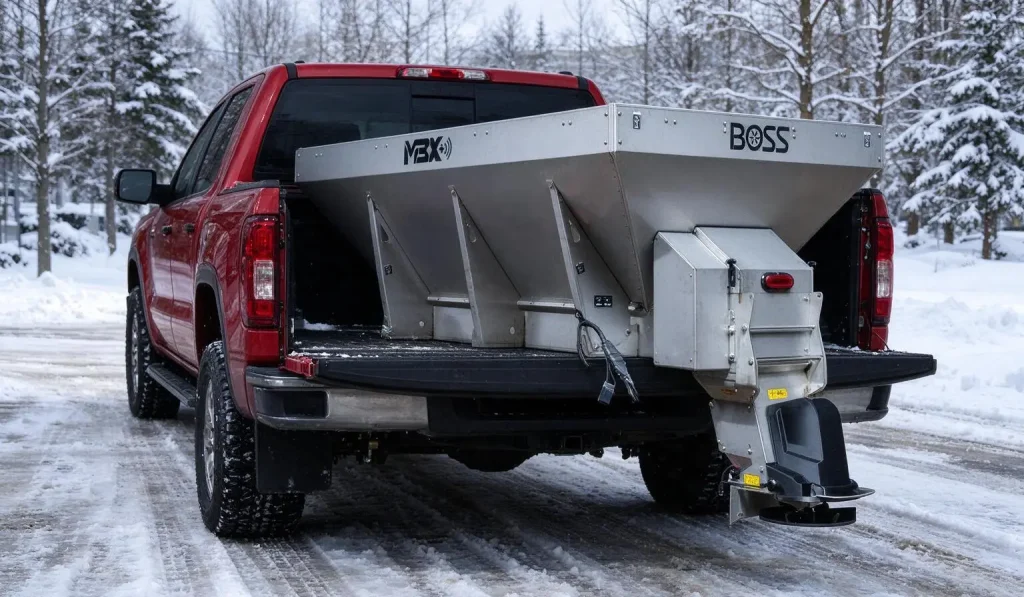
Two spreader auto speed control systems now compete for the commercial hopper market. BOSS AutoSpread Control ships on new VBX+ and MBX+ spreaders. Douglas Dynamics‘ Auto Speed Control retrofits any Western, Fisher or SnowEx Fleet Flex hopper back to 2016. Which pays back faster depends on whether the fleet is buying new or upgrading what it owns.
What a Spreader Rate Controller Does
A spreader rate controller matches material output to vehicle speed automatically. Without that link, output is a function of auger or chain speed alone. A truck slowing for a cul-de-sac over-applies; a truck accelerating onto a highway under-applies. The operator compensates by feel, and the result is inconsistent coverage and wasted material.
Both AutoSpread and Auto Speed Control solve the same problem. The operator sets a target application rate. The controller reads vehicle speed — GPS for BOSS, OBD-II for Douglas Dynamics — and adjusts the auger or chain automatically so the pounds-per-unit-area stays constant regardless of how fast the truck is moving.
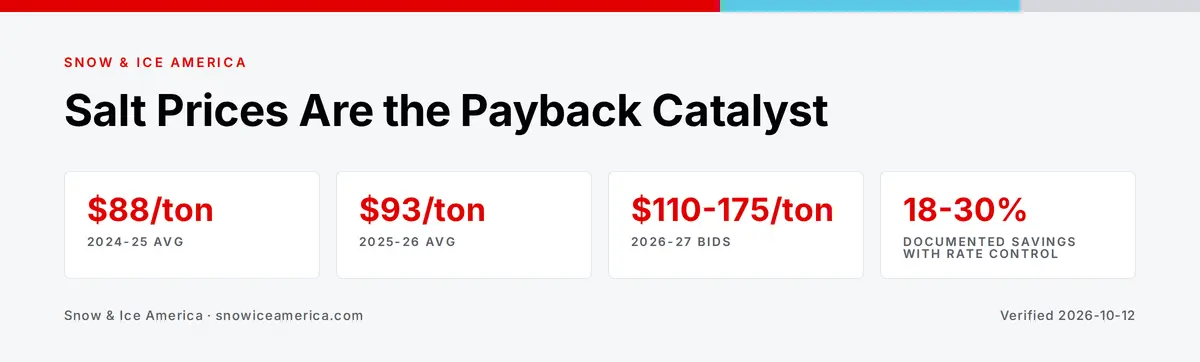
The economic case for that automation has sharpened. Municipal rock salt bids in Illinois climbed from roughly $88 per ton in the 2024-25 season to $110-175 per ton for 2026-27, according to public bid records from Joliet, Cherry Valley and regional reporting by Discovery Alert. Every ton wasted on an uncontrolled pass now costs materially more than it did two seasons ago. (For a full breakdown of the supply situation, see Rock Salt Prices & Supply for Winter 2026-27.)
Documented trials back the savings claims. The city of Lowell, Massachusetts cut salt use by 30 percent and saved over $780,000 after installing electronic spreader controls on 24 trucks, American City & County reported. A separate MassDOT-funded study published through ROSAP found that a machine-sensed controller reduced salt application by 34 to 37 percent compared with manual spreading while maintaining equivalent road-surface grip. Neither figure is an OEM marketing claim; both come from controlled public-sector trials.
BOSS AutoSpread Control
AutoSpread Control is a factory option on the VBX+ (1.5, 2 and 3 yard auger-drive) and MBX+ (4, 5 and 6 yard pintle-chain) spreader lines, according to BOSS’s 2026 new-products page. It is not available as a standalone retrofit.
The system requires Cold Front Technology wiring, a single unified connector that replaces the legacy 13-pin plug used on older BOSS V-box spreaders. That wiring is exclusive to the VBX+ and MBX+ lines, as Lawn & Landscape confirmed when BOSS debuted Cold Front at its 2026 dealer event.
AutoSpread reads GPS-measured vehicle speed and adjusts material flow to maintain a target application rate. The operator selects rate units: per 1,000 square feet, per acre or per lane mile. The system integrates with the standard BOSS LCD controller and records material use for up to 10 job sites, which serves both operational tracking and documentation for contract compliance and slip-and-fall defence.
Pricing is bundled into the spreader purchase. VBX+ spreaders list at roughly $10,900 to $15,100 through Weingartz, depending on capacity. MBX+ pricing is not publicly listed. BOSS has not disclosed the incremental cost of the AutoSpread option, and the company’s Facilities Management Now profile describes limited initial availability for the 2026-27 season.
Douglas Dynamics Auto Speed Control
Auto Speed Control is a retrofit kit — part number 32850 at Fisher, with equivalent kits for Western and SnowEx — compatible with any Fleet Flex hopper spreader manufactured since 2016, according to the Western, Fisher and SnowEx product pages.
Compatible models span the full Fleet Flex hopper lineup: Western Tornado, Striker and Marauder (including Compact, Stainless and Poly variants); Fisher Poly-Caster, SteelCaster and Tempest (including Poly variant); and SnowEx Renegade and HELIXX (including Compact, Stainless and Poly variants).
The kit connects to the truck’s OBD-II diagnostic port for real-time vehicle speed data. The operator sets a desired spread rate, and the controller adjusts auger or chain speed to hold it. An “S” alert appears when the truck is moving too slowly to maintain the set rate; an “F” alert appears when it is moving too fast. A running material counter tracks total output until the operator resets it and logs the figure into a third-party app or a notebook.
The kit ships with the Auto Speed Control unit, a control harness with OBD-II plug, an OBD-II Y-harness, a mounting bracket and hardware. Installation is a four-step process: wire the harness, connect to the spreader control, mount the unit and route the wiring. Douglas Dynamics does not require a dealer install.
A Fisher dealer listing for part #32850 shows a retail price of approximately $750.
Feature Comparison
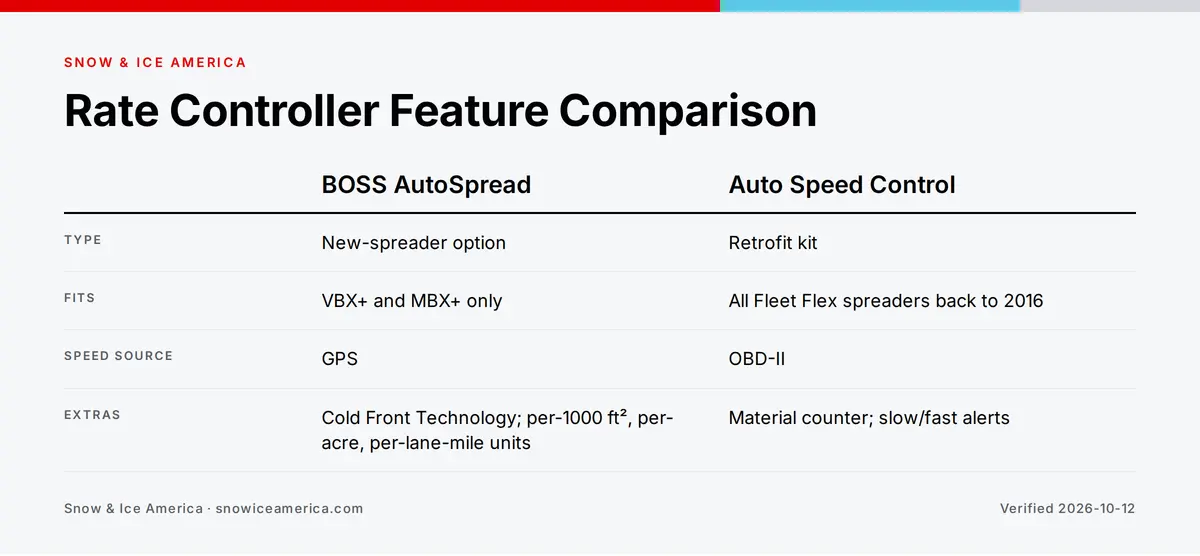
| Feature | BOSS AutoSpread | Auto Speed Control |
|---|---|---|
| Type | Factory option | Retrofit kit |
| Compatible spreaders | VBX+ and MBX+ only | All Fleet Flex hoppers (Western, Fisher, SnowEx) since 2016 |
| Speed source | GPS (Cold Front Technology) | OBD-II diagnostic port |
| Rate-setting units | Per 1,000 ft², per acre, per lane mile | Operator-set target rate |
| Material counter | Integrated with job tracking (up to 10 sites) | Running counter, manual reset |
| Slow/fast alerts | Not disclosed | “S” (too slow) and “F” (too fast) |
| Wiring required | Cold Front Technology (VBX+/MBX+ only) | Fleet Flex (standard since 2016) |
| Approximate price | Bundled into new spreader ($10,900-$15,100 for VBX+) | ~$750 standalone |
| Installation | Dealer-installed with new spreader | Four-step owner install |
| Retrofit capability | No — new spreaders only | Yes — any Fleet Flex unit back to 2016 |
Payback at 2026-27 Salt Prices
The payback calculation depends on two numbers: the cost of the controller and the value of the material it saves.
Retrofitting an existing Fleet Flex fleet. The Auto Speed Control kit costs roughly $750. A truck spreading 80 tons of rock salt per season at $120 per ton runs a material bill of $9,600. A 20 percent reduction — conservative against the 30 percent Lowell measured and the 34-37 percent the ROSAP study found — saves 16 tons, worth $1,920 at that price. The kit pays for itself partway through the first season.
Adding AutoSpread to a new BOSS VBX+ purchase. The incremental cost of the AutoSpread option is not publicly disclosed, so a precise payback figure is not possible to calculate. The material savings are the same order of magnitude — at $120 per ton and a 20 percent reduction on 80 tons, the annual value is roughly $1,920 per truck — but the breakeven point depends on whatever premium the dealer quotes for the option.
Both scenarios use a 20 percent reduction as the working figure, not the 30-37 percent that the Lowell and ROSAP trials documented. Actual savings depend on the operator’s existing calibration discipline, route mix and how much material was being wasted before the controller was installed. A fleet that was already calibrating carefully will save less than one that was running auger speed by feel.
Documentation and Liability
Documentation from both rate controllers matters for slip-and-fall defence and contract compliance.
BOSS’s job-tracking feature logs material use per site for up to 10 sites on the standard LCD controller. The data stays on the controller; it does not upload to a cloud dashboard or telematics platform.
Auto Speed Control’s material counter is simpler. It keeps a running total until the operator resets it. Logging requires the operator to record the figure manually — into a third-party fleet management app, a spreadsheet or a paper notebook.
Neither system is a full telematics or GPS-tracking solution. They record quantities, not locations or timestamps. A fleet that needs route-level documentation will still need a separate telematics package.
Which System Fits Which Fleet
The decision comes down to what the fleet already owns.
Existing Fleet Flex spreaders. Auto Speed Control is the fastest payback path. At roughly $750 per truck and a self-install, the cost is a fraction of a new spreader purchase and the savings begin the first time the truck rolls.
Buying new and open to BOSS. AutoSpread bundles rate control into the new-equipment purchase. The fleet gets a current-generation spreader with Cold Front Technology wiring and job tracking in a single transaction. The tradeoff is that AutoSpread is available only on VBX+ and MBX+ units and requires a BOSS dealer for installation.
Mixed fleet. Auto Speed Control covers the Douglas Dynamics side. AutoSpread comes with new BOSS iron. Both systems can run in the same fleet; neither requires the other.
Older BOSS V-box spreaders with 13-pin wiring. Neither system retrofits them. The upgrade path is a new VBX+ or MBX+ with AutoSpread, or trading the spreader for a Fleet Flex hopper and fitting Auto Speed Control.
Kirk Davies
EditorialWith a career spanning over two decades in the snow and ice industry, and former owner of RWB Snow Service Group, Kirk propelled the company to the forefront of the industry while setting new standards for operational excellence and customer service. Kirk's contributions extend beyond his business achievements. He is a respected thought leader who shares his knowledge and insights throughout the snow and ice industry.
Price your next snow job in 60 seconds.
Estimate per-push, per-inch and seasonal pricing for any lot.