Skid Steer Snow Plows: Matching Attachment to Machine
Maximize your winter work with the best skid steer snow plow; will it be the WESTERN PRO PLUS or the PRODIGY? Discover why.

The question most contractors ask is which brand of skid steer snow plow to buy. That is the wrong first question. Brand matters less than matching the attachment type to the surfaces you clear and the machine you already own — and getting either wrong is how operators end up with an 11-foot blade that will not fit on their trailer, or a pusher that loses traction every time it snows more than four inches.
This guide works in that order: machine first, attachment second, cutting edge third.
Start with the machine, not the plow
Three machine specifications constrain everything you can bolt to the front of a skid steer.
- Rated operating capacity (ROC). The attachment’s rating must match or be lower than the loader’s. This is not a formality — it governs stability when you lift a loaded blade to stack a pile, which is when skid steers become unstable. Virnig recommends a minimum of 1,800 lb operating capacity for their hydraulic blade-pusher combination units.
- Hydraulic flow (GPM). Any attachment with a hydraulic motor — blowers and angle brooms above all — must fall inside its motor’s minimum and maximum flow range. Match your machine’s actual flow to the attachment spec before ordering, and note whether the attachment expects standard or high flow.
- Width against your tracks. The attachment should be wider than the machine’s tires or tracks. If it is not, you drive over the snow you just failed to clear on every pass.
The attachment types, compared
| Attachment | Best for | Typical widths | Main limitation |
|---|---|---|---|
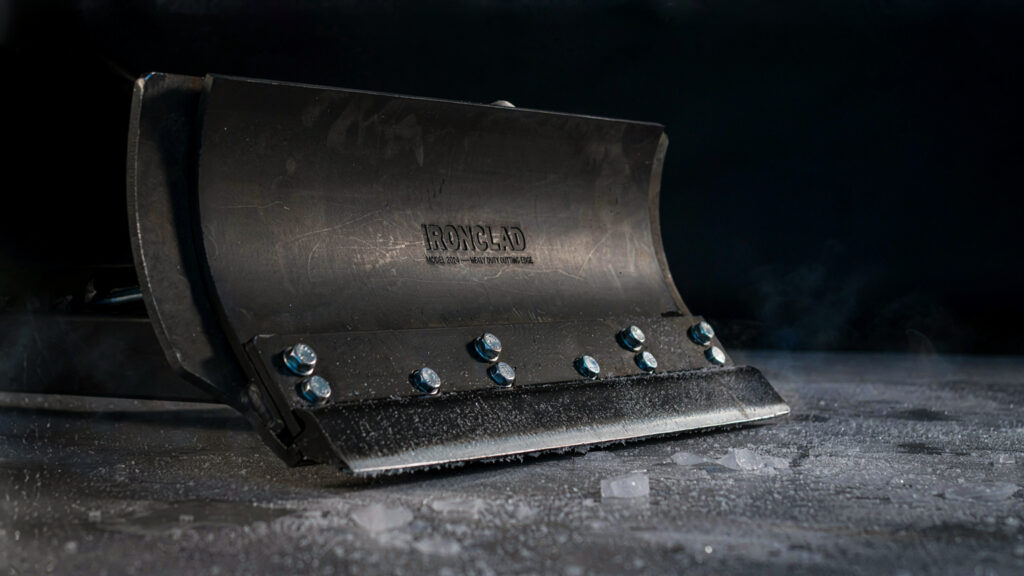
| Snow pusher (box) | Short straight pushes, maximum containment | 84″–96″ small/mid; 108″–120″ large frame | Loses traction in deep or heavy snow |
| Angle blade | Large lots and driveways, windrowing | 84″–96″ small/mid; 108″–120″ large frame | Poor containment; struggles on unfrozen gravel |
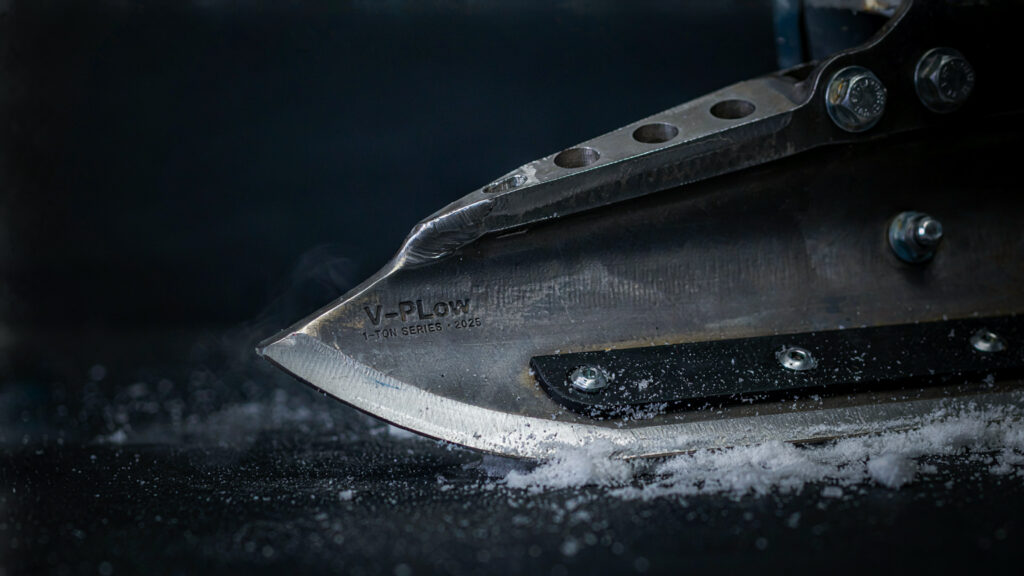
| V-blade | Open ground, bi-directional plowing, stacking | 84″–96″ small/mid; 108″–120″ large frame | Higher cost; poor on unfrozen gravel |
| Hydraulic blade-pusher combo | Versatility on large lots; high stacking | Up to 11′ at full scoop | Needs ~1,800 lb ROC; widest units exceed trailer width |
| Snow bucket | Light snow, granular material, tight budgets | Matched to machine | No moving parts, but useless on hard-pack or ice |
| Snow blower | Deep drifts, confined sites with nowhere to windrow | Flow-dependent | Entirely dependent on hydraulic output |
| Angle broom | Light snow on pavers and sensitive surfaces | 72″ straight, 64″ fully angled | Struggles with heavy accumulation |
Pusher versus blade: the actual trade-off
A pusher carries snow; a blade casts it aside. On a retail lot where you are moving snow to a defined stacking area in straight runs, the pusher moves more per pass and leaves less behind. On a long access road or a site where you want to windrow as you travel, the blade wins because it can angle and you never stop to reposition. Both major manufacturers split their skid-steer lines along exactly this boundary — Fisher and SnowEx each catalogue pushers and straight-blade attachments as separate product families rather than variants of one.
The pusher’s weakness is traction. Containment means the machine has to carry the entire load, and in deep or wet snow a skid steer will spin before the box fills.
Why a V-blade outranks an angle blade on capability
As Virnig puts it: a V-blade can imitate an angle blade, but an angle blade can never imitate a V-blade. The V gives you scoop position for carrying, V position to split a drift, flat position to push straight and left or right angles to windrow. Skid Pro lists five blade positions on their skid loader V-plow for exactly this reason.
You pay for that range. If every site you service is an open lot cleared in one direction, the angle blade does the job for less money.
The combination units
Hydraulic blade-pusher attachments convert between straight blade and pusher on the fly, with any position in between — the design Kage Innovation built its SnowFire system around. For a contractor running mixed sites on one machine, that removes a trip back to the yard to swap attachments. Two constraints: the operating-capacity floor mentioned above, and physical width. A unit measuring 11 feet at full scoop is not something every trailer can legally carry — check your trailer and your state’s width rules before ordering the biggest one available.
Cutting edges change the job more than most buyers expect
| Edge | Scraping | Surface risk | Suits |
|---|---|---|---|
| Steel | Best | Wears sealants on asphalt and concrete | Hard-pack, ice, back-dragging |
| Poly (UHMW) | Better bite than rubber | Does not mark surfaces | Decorative concrete, sealed lots |
| Rubber | Least aggressive | Lowest — prevents surface damage | Fresh snow and slush, pavers |
If you service a property with stamped or sealed concrete, the edge choice is a liability decision as much as a performance one. Steel scrapes best and will take the sealant with it.
Constraints that catch people out
- Unfrozen gravel. Blades and V-blades do not work well on gravel unless the ground is frozen. If you service rural or industrial yards, plan for that or fit shoes.
- Stacking height versus stability. The moment the boom goes up with a loaded attachment, your effective capacity drops. Size the attachment for the stacking you actually do, not the pushing.
- Trailer width. The widest combination units exceed what a standard trailer carries legally.
- Flow mismatch. Ordering a blower rated above your machine’s flow does not give you a slow blower; it gives you one that underperforms and can damage the motor.
Matching attachment to property type
- Retail and commercial lots with a stacking corner — pusher, or a combination unit if the same machine also runs roads.
- Long driveways and access roads — angle blade, or V-blade if drifting is routine.
- Mixed portfolio on one machine — hydraulic blade-pusher combination, capacity permitting.
- Confined sites with nowhere to put snow — blower, sized to your flow.
- Pavers, plazas and sensitive surfaces — angle broom for light events, poly or rubber edge otherwise.
What about loaders and tractors?
The same attachment logic applies, but the constraint order changes. Wheel loaders carry far higher operating capacity, so width and stacking height become the governing factors rather than stability, and pushers scale to sizes no skid steer can carry. Tractors introduce a third variable — three-point hitch category and PTO availability — which determines whether you are looking at a mounted blade, a rear blade or a PTO blower. Do not assume a skid steer attachment transfers across on a universal plate alone.
Frequently asked questions
What size snow plow do I need for a skid steer?
Wide enough to clear outside your tires or tracks, and rated at or below your machine’s operating capacity. In practice that puts most small-to-mid skid steers on 84″ or 96″ attachments, with 108″ and 120″ reserved for large-frame machines.
Is a snow pusher better than a plow for a skid steer?
For straight pushes on open lots where containment matters, yes — a pusher carries more snow per pass. For windrowing along roads or driveways, an angle or V-blade is better because it casts snow aside without stopping. Traction is the pusher’s limitation in deep or wet snow.
Do I need high-flow hydraulics for a skid steer snow plow?
Not for blades and pushers, which use hydraulics only for angling. You do need to match flow for attachments driven by a hydraulic motor — snow blowers and angle brooms — where the machine’s GPM must fall inside the motor’s specified range.
Can I use a skid steer snow plow on gravel?
Only reliably when the ground is frozen. On unfrozen gravel a blade digs in and drags material across the surface. Rubber or poly edges and skid shoes reduce the problem but do not eliminate it.
What cutting edge should I choose?
Steel for maximum scraping on hard-pack and ice, accepting that it wears sealant on asphalt and concrete. Poly for a good bite without marking finished surfaces. Rubber for fresh snow and slush on surfaces you cannot risk damaging.
Kirk Davies
EditorialWith a career spanning over two decades in the snow and ice industry, and former owner of RWB Snow Service Group, Kirk propelled the company to the forefront of the industry while setting new standards for operational excellence and customer service. Kirk's contributions extend beyond his business achievements. He is a respected thought leader who shares his knowledge and insights throughout the snow and ice industry.
Price your next snow job in 60 seconds.
Estimate per-push, per-inch and seasonal pricing for any lot.